Effect of jatropha-placenta-cmc formulation on second-degree burn wound healing in rats: Fibroblast growth factor expression
DOI:
https://doi.org/10.35816/jiksh.v15i2.380Keywords:
burns, carboxymethyl chitosan, fibroblast growth factor, placenta extract, wound healingAbstract
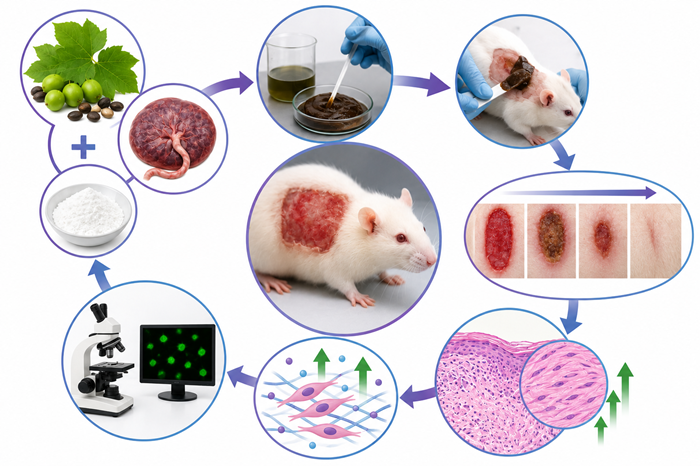
Introduction: Second-degree burns require effective topical therapy to accelerate tissue regeneration and reduce complications. Current treatments remain limited by side effects and suboptimal regenerative outcomes. This study aimed to evaluate the effectiveness of a combination gel of Jatropha multifida L. latex, placenta extract, and carboxymethyl chitosan (JM–P–CMC) on burn wound healing by assessing fibroblast growth factor (FGF) expression, fibroblast count, and collagen density.
Research Methodology: A post-test-only controlled experimental design was conducted using 18 male Sprague-Dawley rats, allocated into 6 groups. Standardised second-degree burns (1×1 cm) were induced and treated for 15 days. Histological and immunohistochemical analyses were performed at days 5, 10, and 15. Data were analysed using the Kruskal–Wallis and Mann–Whitney tests (α=0.05), with effect sizes expressed as median differences (%) and 95% confidence intervals (CI).
Results: The JM–P–CMC group demonstrated significantly higher FGF expression compared to saline (Day 15 median: 75 vs 33; =42%; p=0.0015; 95% CI: 18–60). Fibroblast counts were also significantly increased (median: 55 vs 17; =38%; p=0.0001; 95% CI: 20–64). Collagen density was markedly higher in the intervention group (58.83% vs 21.70%; p<0.01). A strong positive correlation was observed between fibroblast count and collagen density on day 10, whereas FGF showed an inverse regulatory relationship with collagen during the remodelling phase.
Conclusion: The JM–P–CMC gel significantly enhances burn wound healing through modulation of FGF expression, fibroblast proliferation, and collagen deposition. This formulation represents a promising, safe, and cost-effective alternative for topical burn management and supports the integration of bioactive-based therapies into clinical and nursing practice.
Downloads
References
Ali Khan, B., Karim, F., Khalid Khan, M., Haider, F., & Khan, S. (2021). Synthesis and characterization of polymeric responsive CMC/Pectin hydrogel films loaded with Tamarix aphylla extract as potential wound dressings. BIOCELL, 45(5), 1273–1285. https://doi.org/10.32604/biocell.2021.015323
Alven, S., & Aderibigbe, B. A. (2020). Chitosan and Cellulose-Based Hydrogels for Wound Management. International Journal of Molecular Sciences, 21(24), 9656. https://doi.org/10.3390/ijms21249656
Ardizzone, A., Bova, V., Casili, G., Repici, A., Lanza, M., Giuffrida, R., Colarossi, C., Mare, M., Cuzzocrea, S., Esposito, E., & Paterniti, I. (2023). Role of Basic Fibroblast Growth Factor in Cancer: Biological Activity, Targeted Therapies, and Prognostic Value. Cells, 12(7), 1002. https://doi.org/10.3390/cells12071002
Asl, A. N., Akbarzadeh, A., Hajishoreh, N. K., & Sheervalilou, R. (2026). Nanostructured natural materials in wound healing: mechanisms, cytokine signaling, and therapeutic applications. Discover Applied Sciences, 8(2), 210. https://doi.org/10.1007/s42452-026-08224-w
Bastari, B. B., Yunita, E., Sari, K., Asteria, M., Famil, J., & Oktoviani, O. (2023). Comparison of Propolis Extracts and Bioplacenton at Epidermal Re-epithelialization Process in Burn Wound of Mice (Mus musculus). Sang Pencerah: Jurnal Ilmiah Universitas Muhammadiyah Buton, 9(2), 355–363. https://doi.org/10.35326/pencerah.v9i2.3007
Berry, C. E., Brenac, C., Gonzalez, C. E., Kendig, C. B., Le, T., An, N., & Griffin, M. F. (2024). Natural Compounds and Biomimetic Engineering to Influence Fibroblast Behavior in Wound Healing. International Journal of Molecular Sciences, 25(6), 3274. https://doi.org/10.3390/ijms25063274
Bobrova, O., Naumenko, Y., Shchetinskyi, M., Narozhnyi, S., Nardid, O., Kalashnykova, М., & Shchetinska, I. (2022). Low-Temperature Storage of Placenta Affects Anti-Inflammatory and Wound Healing Properties of Its Extracts. Problems of Cryobiology and Cryomedicine, 32(2), 144–157. https://doi.org/10.15407/cryo32.02.144
Chandra, P., Faizan, M., Porwal, M., Sharma, H., & Sachan, N. (2026). An Overview and Review of Growth Factors in Wound Healing: Emerging Trends and Innovations. Current Diabetes Reviews, 22(1). https://doi.org/10.2174/0115733998332692241202072249
Cheng, S., Lv, R., Xu, J., Hirman, A. R., & Du, L. (2021). IGF-1-Expressing Placenta-Derived Mesenchymal Stem Cells Promote Scalding Wound Healing. Journal of Surgical Research, 265, 100–113. https://doi.org/10.1016/j.jss.2021.02.057
Čoma, M., Fröhlichová, L., Urban, L., Zajíček, R., Urban, T., Szabo, P., Novák, Š., Fetissov, V., Dvořánková, B., Smetana, K., & Gál, P. (2021). Molecular Changes Underlying Hypertrophic Scarring Following Burns Involve Specific Deregulations at All Wound Healing Stages (Inflammation, Proliferation and Maturation). International Journal of Molecular Sciences, 22(2), 897. https://doi.org/10.3390/ijms22020897
Dah-Nouvlessounon, D., Chokki, M., Agossou, E. A., Houédanou, J.-B., Nounagnon, M., Sina, H., Vulturar, R., Heghes, S. C., Cozma, A., Mavoungou, J. F., Fodor, A., Baba-Moussa, F., Suharoschi, R., & Baba-Moussa, L. (2023). Polyphenol Analysis via LC-MS-ESI and Potent Antioxidant, Anti-Inflammatory, and Antimicrobial Activities of Jatropha multifida L. Extracts Used in Benin Pharmacopoeia. Life, 13(9), 1898. https://doi.org/10.3390/life13091898
Elbialy, Z. I., Atiba, A., Abdelnaby, A., Al-Hawary, I. I., Elsheshtawy, A., El-Serehy, H. A., Abdel-Daim, M. M., Fadl, S. E., & Assar, D. H. (2020). Collagen extract obtained from Nile tilapia (Oreochromis niloticus L.) skin accelerates wound healing in rat model via up regulating VEGF, bFGF, and α-SMA genes expression. BMC Veterinary Research, 16(1), 352. https://doi.org/10.1186/s12917-020-02566-2
Fahrurroji, A., Suhandi, C., Chaerunisaa, A., Pratiwi, L., & Sriwidodo, S. (2026). Natural Bioactive-Based Advanced Wound Dressings for Diabetic Wound Healing: A Systematic Review of Emerging Biomaterial Platforms. International Journal of Nanomedicine, Volume 21, 1–30. https://doi.org/10.2147/IJN.S588990
Farooq, M., Khan, A. W., Kim, M. S., & Choi, S. (2021). The Role of Fibroblast Growth Factor (FGF) Signaling in Tissue Repair and Regeneration. Cells, 10(11), 3242. https://doi.org/10.3390/cells10113242
Hernandez-Hernandez, A. B., Alarcon-Aguilar, F. J., Garcia-Lorenzana, M., Rodriguez-Monroy, M. A., & Canales-Martinez, M. M. (2021). Jatropha Neopauciflora Pax Latex Exhibits Wound-Healing Effect in Normal and Diabetic Mice. Journal of Evidence-Based Integrative Medicine, 26, 2515690X20986762. https://doi.org/10.1177/2515690X20986762
Keshri, V. R., Peden, M., Singh, P., Norton, R., Abimbola, S., & Jagnoor, J. (2023). Health systems research in burn care: an evidence gap map. Injury Prevention, 29(5), 446–453. https://doi.org/10.1136/ip-2023-044963
Mai, B., Jia, M., Liu, S., Sheng, Z., Li, M., Gao, Y., Wang, X., Liu, Q., & Wang, P. (2020). Smart Hydrogel-Based DVDMS/bFGF Nanohybrids for Antibacterial Phototherapy with Multiple Damaging Sites and Accelerated Wound Healing. ACS Applied Materials & Interfaces, 12(9), 10156–10169. https://doi.org/10.1021/acsami.0c00298
Miri, S., Rashtiani, S., Zabihi, M. R., Akhoondian, M., & Farzan, R. (2024). Role of exercise in nursing care for burn wound patients: A narrative review from a nursing perspective. Journal of Nursing Reports in Clinical Practice, 2(2), 0–0. https://doi.org/10.32598/JNRCP.23.101
Ren, J. (2025). Epigenetic remodeling of M2 macrophage polarization in skin wound healing: Mechanisms and therapeutic implications. Journal of Radiation Research and Applied Sciences, 18(4), 102072. https://doi.org/10.1016/j.jrras.2025.102072
Sánchez-Hernández, A., & Martínez-Flor, A. (2022). Teaching the pragmatics of English as an international language: A focus on pragmatic markers. Language Teaching Research, 26(2), 256–278. https://doi.org/10.1177/13621688211064933
Shore, C. B., Maben, J., Mold, F., Winkley, K., Cook, A., & Stenner, K. (2022). Delegation of medication administration from registered nurses to non-registered support workers in community care settings: A systematic review with critical interpretive synthesis. International Journal of Nursing Studies, 126, 104121. https://doi.org/10.1016/j.ijnurstu.2021.104121
Syaharuddin, & Fardi. (2026). Effectiveness of 0.9% Sodium Chloride Irrigation and Oral Propolis in Diabetic Foot Ulcer Infection: A Case Study. Jurnal Ilmiah Kesehatan Sandi Husada, 15(1), 252–261. https://doi.org/10.35816/jiksh.v15i1.248
Wang, F., Gao, Y., Li, H., Zhou, L., Shi, H., Feng, S., Chen, J., & Mei, Z. (2022). Effect of natural-based biological hydrogels combined with growth factors on skin wound healing. Nanotechnology Reviews, 11(1), 2493–2512. https://doi.org/10.1515/ntrev-2022-0122
Yang, B.-Y., Zhou, Z.-Y., Liu, S.-Y., Shi, M.-J., Liu, X.-J., Cheng, T.-M., Deng, G.-Y., Tian, Y., Song, J., & Li, X.-H. (2022). Porous Se@SiO2 Nanoparticles Enhance Wound Healing by ROS-PI3K/Akt Pathway in Dermal Fibroblasts and Reduce Scar Formation. Frontiers in Bioengineering and Biotechnology, 10, 852482. https://doi.org/10.3389/fbioe.2022.852482
Zhao, X. Y., Chen, Y. M., Cao, K., Song, H. M., Yasz, Y., Li, J. H., Wang, R. Q., & Zrínyi, M. (2026). Alanine-modified cellulose nanofibril hydrogel bioadhesives: An injectable angiogenic platform for promoting wound healing. International Journal of Biological Macromolecules, 368, 152124. https://doi.org/10.1016/j.ijbiomac.2026.152124
Downloads
Published
How to Cite
Issue
Section
Citation Check
License
Copyright (c) 2026 Mellyna Mellyna, Juniarti Juniarti, Nunung Ainur Rahmah, Restu Syamsul Hadi, Nabila Pyrenina Thamrin

This work is licensed under a Creative Commons Attribution 4.0 International License.
Statement:
The authors retain the copyright of this work and grant Jurnal Ilmiah Kesehatan Sandi Husada the right of first publication. The work is simultaneously licensed under a Creative Commons Attribution 4.0 International License (CC BY 4.0), which permits use, distribution, and reproduction in any medium, provided the original author(s) and the initial publication in this journal are properly credited.
The authors are permitted to copy and redistribute the published version of the work, including posting it to an institutional repository or including it in a book, with acknowledgment of its initial publication in Jurnal Ilmiah Kesehatan Sandi Husada.