Effectiveness of tiktok and instagram based education in improving adolescent reproductive health literacy in bone regency: An explanatory sequential mixed-methods study
DOI:
https://doi.org/10.35816/jiksh.v15i2.401Keywords:
Adolescent Health, Digital Health Education, Generation Z, Reproductive Health Literacy, Social MediaAbstract
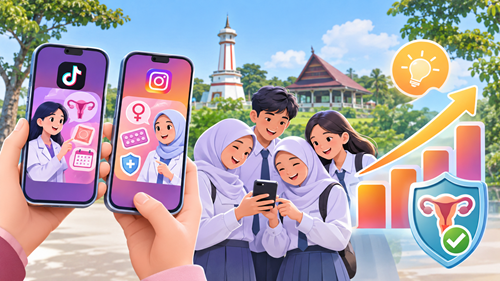
Introduction: Social and cultural barriers may limit adolescents’ access to reproductive health information. This study examined changes in reproductive health literacy following social media-based education and explored adolescents’ experiences in Bone Regency, Indonesia.
Research Methodology: An explanatory sequential mixed-methods study was conducted in four schools. Two schools were allocated to the intervention and two to the control condition. The analysis included 114 adolescents (57 per group). The intervention lasted four weeks. Qualitative findings were obtained through focus group discussions (12 participants) and in-depth interviews (6 participants). Quantitative comparisons used nonparametric tests, and qualitative data were analyzed thematically. Cluster-adjusted estimates were not reported and require reanalysis.
Results: Mean literacy scores increased from 52.4 to 78.6 in the intervention group (a 26.2-point change) and from 51.8 to 55.2 in the control group (a 3.4-point change). The unadjusted difference in changes was 22.8 points. Exploratory platform subgroups showed mean changes of 27.8 points for TikTok (n = 38), 23.4 for Instagram (n = 13), and 29.6 for multiplatform use (n = 6). Qualitative themes concerned privacy, contextual relevance, cultural norms, peer dissemination, and culturally sensitive content. Statistical significance and effect sizes must be reassessed with clustering accounted for.
Conclusion: Social media-based reproductive health education was associated with improved measured literacy in the participating schools. Platform comparisons are exploratory, and the proposed Digital Contextual Education Model (DiCEM) requires independent validation. The design does not establish changes in actual reproductive health behavior.
Downloads
References
Angraeni, S., Adam, A., & Alim, A. (2025). Makna Sosial Dan Budaya Mahasiswi Terhadap Pencegahan Kehamilan Tidak Diinginkan Di Era Digital: Studi Kualitatif Pada Mahasiwi Kebidanan Universitas Mega Buana Palopo. Diagnosis Jurnal Ilmiah Kesehatan, 20(2), 1–11. https://doi.org/10.35892/jikd.v20i2.2736
Aswar, A., Adam, A., Alim, A., Munadhir, M., & Adnan, Y. (2025). Studi kualitatif; pengalaman remaja dalam menghadapi perubahan sosial budaya dan tantangan kesehatan reproduksi di era digital. Jurnal Kesehatan Marendeng, 9(2), 201–209. https://doi.org/10.58554/jkm.v9i02.150
Bone, D. K. K. (2023). Health profile of Bone Regency in 2022. In Bone Regency Health Office.
Cavanagh, T. M., & Kiersch, C. (2023). Using commonly-available technologies to create online multimedia lessons through the application of the Cognitive Theory of Multimedia Learning. Educational Technology Research and Development, 71(3), 1033–1053. https://doi.org/10.1007/s11423-022-10181-1
Cilubai, J., & & Maheswari, U. (2024). Comparative analysis of social media-based interventions for adolescent reproductive health education. African Journal of Reproductive Health, 28(3). https://doi.org/https://dx.doi.org/10.29063/ajrh2024/v28i3.9
Dewi, T. P., Indirayani, I., Intania, R., & Azra, S. (2024). Pregnancy and childbirth characteristics description in teenagers Aged 15 to 19 years old in dr. Zainoel Abidin general hospital Banda Aceh in January 2020 to December 2022. Jurnal Kedokteran Syiah Kuala, 24(1). https://doi.org/10.24815/jks.v24i1.32080
Fadillah, R. N., & & Mulyati, S. (2024). The effect of reproductive health education content on TikTok on adolescents’ attitudes about risky sexual behavior in Makassar City: Quasi-experimental study. Journal of Public Health Sciences, 13(1). https://doi.org/10.33221/jikm.13.1.45
Feijó da Silva, T., Lutz Martins, E., Bittencourt de Miranda, R., Pinto de Almeida, H., de Moura Rodrigues, J., Santos Moreira, B., Silva de Menezes, N., & & Alves Paixão, L. (2025). Promoting Health Literacy in Adolescence in Two Public Schools in Rio de Janeiro: Action Research. Gaúcha de Enfermagem Magazine, 46(spe1). https://doi.org/10.1590/1983-1447.2025.20250084.en
Gelgelo, D., Abeya, S. G., Hailu, D., Edin, A., & Gelchu, S. (2023). Effectiveness of Health Education Interventions Methods to Improve Contraceptive Knowledge, Attitude, and Uptake Among Women of Reproductive Age, Ethiopia: A Systematic Review and Meta-Analysis. Health Services Research and Managerial Epidemiology, 10, 23333928221149264. https://doi.org/10.1177/23333928221149264
Grulich, A. E., Mercer, C. H., Sturrock, B., Baral, S., Turpin, N., Phanuphak, N., Rowley, J., Wi, T., Gemzell-Danielsson, K., García-Moreno, C., Ganatra, B., Kiarie, J., Mburu, G., Bateson, D., Canfell, K., Aggleton, P., Head, J. M., & Mayer, K. H. (2025). Partial progress in sexual and reproductive health and rights: the influence of sociocultural, behavioural, structural, and technological changes on epidemiological trends. The Lancet, 406(10515), 2100–2118. https://doi.org/10.1016/S0140-6736(25)01188-2
Guetterman, T. C., Fetters, M. D., & Creswell, J. W. (2015). Integrating Quantitative and Qualitative Results in Health Science Mixed Methods Research Through Joint Displays. The Annals of Family Medicine, 13(6), 554–561. https://doi.org/10.1370/afm.1865
Harini, R., Hidayah, E. R., Arief, Y. S., & Triharini, M. (2026). Parent-adolescent communication and self-reported sexual health risk behaviour among adolescent girls: a cross-sectional study. Pediomaternal Nursing Journal, 12(2), 142–148. https://doi.org/10.20473/pmnj.v12i2.82165
Kayalkar, V. D., & Dmello, M. K. (2024). Health literacy among rural adolescents in Amravati, Maharashtra: A Community based cross-sectional study. Clinical Epidemiology and Global Health, 26, 101532. https://doi.org/10.1016/j.cegh.2024.101532
Lawal, O. A., & Stvilia, B. (2025). Assessing the Credibility of Health Information from Social Media Influencers: A Systematic Review and a Model of Young Adults’ Evaluation Behaviors. Proceedings of the Association for Information Science and Technology, 62(1), 371–383. https://doi.org/10.1002/pra2.1263
Mintasih, D., Sukiman, S., & Purnama, S. (2024). Integration of Digital Technology in Islamic Religious Education Learning: A Qualitative Study on Teachers’ Competence and Implementation Models in Secondary Schools. Jurnal Pendidikan Islam, 13(1), 85–96. https://doi.org/10.14421/jpi.2024.131.85-96
Mohammadi, N. K., Shamsi, M., & & Khorsandi, M. (2022). Development and validation of a reproductive health literacy scale for adolescents: A mixed-methods study from Iran. In BMC Public Health (Vol. 22, Issue 1). https://doi.org/10.1186/s12889-022-13647-4
Mukhalalati, B., Elshami, S., Eljaam, M., Hussain, F. N., & Bishawi, A. H. (2022). Applications of social theories of learning in health professions education programs: A scoping review. Frontiers in Medicine, 9. https://doi.org/10.3389/fmed.2022.912751
Okumu, M., Logie, C. H., Koomson, I., Nyoni, T., Muzei, J., Sharma, B. B., Cohen, F., Byansi, W., Thompson, M. G., Wabwire, J. C., Nafula, C. N., Hakiza, R., Kyambadde, P., & Windsor, L. C. (2025). Digital Health Literacy and Its Role in Awareness of and Access to Sexual Health Products and Services Among Displaced Youth in Uganda’s Informal Urban Settlements: Community-Based Cross-Sectional Study. Journal of Medical Internet Research, 27, e78343. https://doi.org/10.2196/78343
Orben, A., Meier, A., Dalgleish, T., & Blakemore, S.-J. (2024). Mechanisms linking social media use to adolescent mental health vulnerability. Nature Reviews Psychology, 3(6), 407–423. https://doi.org/10.1038/s44159-024-00307-y
Rahman, F. A., Sari, D. K., & & Nugroho, P. (2023). Effectiveness of Instagram-based educational interventions on adolescent reproductive health knowledge in Surabaya. Journal of Reproductive Health, 14(2). https://doi.org/10.22435/jkr.14.2.89
Sawidi, H., Fara, G. R., Fitri, A. R., & Nurpratiwi, V. (2025). Edukasi kesehatan reproduksi pada remaja di SMA Negeri 8 Makassar. JOURNAL of Public Health Concerns, 5(7), 367–373. https://doi.org/10.56922/phc.v5i7.1214
Shiba, H. A. A., Ismail, S. S., Yousef, A., & El-Kurdy, R. (2025). The role of gender and digital health literacy in shaping nursing students’ knowledge of Polycystic Ovary Syndrome. Nurse Education in Practice, 89, 104602. https://doi.org/10.1016/j.nepr.2025.104602
South, B. P. S. S. (2023). Population profile of South Sulawesi based on the results of the 2020 population census. In BPS South Sulawesi Province. BPS South Sulawesi Province.
Suprapto, S., Rakhman, B., Herianto, D., Wijaya, I., & Yulianti, S. (2026). Strategies to Improve the Quality of Health Services in Indonesia: A Qualitative Study. Journal of Research and Health, 16(6), 9. https://doi.org/http://dx.doi.org/10.32598/JRH.16.6.2929.1
Suprapto, Yuriatson, Menga, M. K., Arda, D., Syamsi, N. L. N., Mulat, T. C., Djaha, Y. T., & Angreani, T. A. (2026). Strategies to improve health service quality in Indonesia: a qualitative study. BMC Health Services Research, 26(1), 1203. https://doi.org/10.1186/s12913-026-14221-x
Syam, H., Jehanara, Lucky Safitri, J., & Yulfitria, F. (2021). Utilization of social media on reproductive health knowledge among adolescents. SEAJOM: The Southeast Asia Journal of Midwifery, 6(2), 81–86. https://doi.org/10.36749/seajom.v6i2.139
Takeda, T., Yoshimi, K., Kai, S., & Inoue, F. (2025). eHealth Literacy and Adolescent Health in Japanese Female High School Students in Sendai: Cross-Sectional Study. JMIR Pediatrics and Parenting, 8, e73237. https://doi.org/10.2196/73237
Ula, Z., Azza, A., Zakiyyah Putri, S., Ayu Rahmadani, R., & Indryani, I. (2026). Effectiveness of comprehensive reproductive health education on adolescent sexual risk behavior and health literacy: quasi-experimental study. Jurnal Ilmiah Kesehatan Sandi Husada, 15(2), 512–521. https://doi.org/10.35816/jiksh.v15i2.371
WHO. (2024). The adolescent health indicators recommended by the Global Action for Measurement of Adolescent health: guidance for monitoring adolescent health at country, regional and global levels. World Health Organization.
Zimmermann, E., & Tomczyk, S. (2025). The Ways of Using Social Media for Health Promotion Among Adolescents: Qualitative Interview and Focus Group Study. Journal of Medical Internet Research, 27, e71510. https://doi.org/10.2196/71510
Downloads
Published
How to Cite
Issue
Section
Citation Check
License
Copyright (c) 2026 Syahridayanti Syahridayanti, Leli Leli, Rahmiyani Saad, Liska Alfaaizin, Jumiyati Jumiyati

This work is licensed under a Creative Commons Attribution 4.0 International License.
Statement:
The authors retain the copyright of this work and grant Jurnal Ilmiah Kesehatan Sandi Husada the right of first publication. The work is simultaneously licensed under a Creative Commons Attribution 4.0 International License (CC BY 4.0), which permits use, distribution, and reproduction in any medium, provided the original author(s) and the initial publication in this journal are properly credited.
The authors are permitted to copy and redistribute the published version of the work, including posting it to an institutional repository or including it in a book, with acknowledgment of its initial publication in Jurnal Ilmiah Kesehatan Sandi Husada.