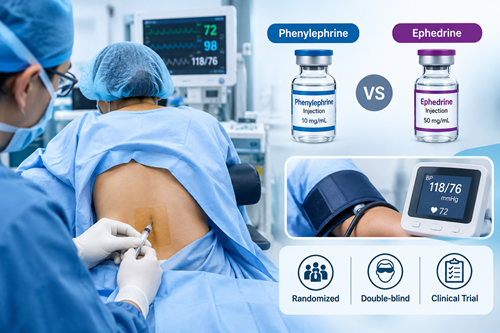
Phenylephrine versus ephedrine as prophylactic vasopressors for spinal anesthesia-induced hypotension: A randomized double-blind clinical trial

DOI:
https://doi.org/10.35816/jiksh.v15i2.396Keywords:
anesthesia, spinal, ephedrine, Hemodynamics, hypotension, phenylephrineAbstract
Introduction: Spinal anesthesia-induced hypotension (SAIH) remains one of the most frequent hemodynamic complications during spinal anesthesia, particularly among high-risk surgical patients. Vasopressor agents such as phenylephrine and ephedrine are commonly administered to prevent hypotension; however, their comparative effectiveness in maintaining hemodynamic stability remains controversial. This study aimed to analyze the differences between phenylephrine and ephedrine in preventing SAIH among patients undergoing surgery with spinal anesthesia at Haji Adam Malik General Hospital, Medan.
Research Methodology: A double-blind randomized clinical trial was conducted between July and September 2023 at Haji Adam Malik General Hospital, Medan. A total of 38 elective surgical patients receiving spinal anesthesia were randomly allocated into two groups: phenylephrine bolus 50 μg (n=19) and ephedrine bolus 5 mg (n=19). Hemodynamic parameters, including systolic and diastolic blood pressure and heart rate, were measured every 2 minutes for 30 minutes after spinal anesthesia. Data were analyzed using an independent t-test and Mann–Whitney test with a significance level of p<0.05.
Results: No statistically significant differences were observed in baseline demographic characteristics between groups (p>0.05). Systolic blood pressure was significantly higher in the ephedrine group at minutes 18–22 after spinal anesthesia (T9–T11) compared with the phenylephrine group (p=0.026; p=0.039; p=0.031, respectively). No significant differences in diastolic blood pressure were found during the observation period (all p > 0.05). Heart rate was significantly higher in the ephedrine group during the first 14 minutes of observation, particularly at T4 and T5 (90.6±11.2 vs 73.3±17.3 bpm; p=0.001 and 90.3±8.6 vs 71.0±14.5 bpm; p=0.001).
Conclusion: Phenylephrine and ephedrine demonstrated comparable effectiveness in maintaining systolic and diastolic blood pressure during spinal anesthesia. However, ephedrine was associated with a significantly greater heart rate response than phenylephrine. Phenylephrine may therefore be considered a preferable option for preventing SAIH in patients requiring more stable heart rate control
Downloads
References
AbdelRady, M. M., AboElfadl, G. M., Ibrahim, M. N., El-Morabaa, H. A. I., Aboelfadl, A. M., & Aboulfotouh, A. (2024). Role of Granisetron in preventing hypotension after spinal anaesthesia with Levobupivacaine in rheumatic patients undergoing elective cesarean section: A randomized controlled trial. Perioperative Care and Operating Room Management, 37, 100439. https://doi.org/10.1016/j.pcorm.2024.100439
Antar, S. S., Metaweh, A., Neamatallah, H., Abdelfattah, M., Abdelbaser, I., & Awad, K. A. (2025). Preoperative oral caffeine as prophylaxis against post-spinal hypotension in patients undergoing orthopedic lower limb surgery: A randomized, placebo-controlled, double-blinded study. Anaesthesia Critical Care & Pain Medicine, 44(4), 101537. https://doi.org/10.1016/j.accpm.2025.101537
Astete B, M., Basso V, L., & Lacassie, H. J. (2024). Vasoactive drugs for the management of maternal arterial hypotension after spinal anesthesia for cesarean section. An updated integrative narrative review. Trends in Anaesthesia and Critical Care, 58, 101491. https://doi.org/10.1016/j.tacc.2024.101491
Ben Marzouk, S., Fouzai, B., Dhraief, N., Ben Amor, F., Hkiri, T., Hamdi, H., Trablesi, S., Kalai, A., & Maghrebi, H. (2026). Cardiac ultrasound-guided crystalloid preloading before spinal anesthesia vs. standard coloading for scheduled cesarean delivery: a randomized controlled trial. International Journal of Obstetric Anesthesia, 66, 104840. https://doi.org/10.1016/j.ijoa.2025.104840
Brenders, A., Bleeser, T., Deprest, J., Rex, S., & Devroe, S. (2025). Effect of vasoactive drugs used for management of hypotension during pregnancy on uterine hemodynamic parameters: a systematic review and meta-analysis of preclinical and clinical studies. International Journal of Obstetric Anesthesia, 61, 104287. https://doi.org/10.1016/j.ijoa.2024.104287
Buddeberg, B. S., Seeberger, E., Bläsi, C., Dutilh, G., Steiner, L. A., Bandschapp, O., Palanisamy, A., & Girard, T. (2024). Is crystalloid co-loading necessary to prevent spinal hypotension during elective cesarean delivery? A randomized double-blind trial. International Journal of Obstetric Anesthesia, 58, 103968. https://doi.org/10.1016/j.ijoa.2023.103968
Duttala, S., Kumari, K., Kumari, V., Meshram, T., Sharma, A., Sethi, P., Rathod, D., Bhatia, P., & Goyal, S. (2025). Dexamethasone for prevention of spinal hypotension during caesarean delivery: a randomised controlled trial. International Journal of Obstetric Anesthesia, 61, 104286. https://doi.org/10.1016/j.ijoa.2024.104286
Eldemrdash, A. M., Elsharkawy, M. F., Ghoniem, B. M., Abdelsalam, W., Hammad, S. S., Hemaida, T. S., Ragheb, A. M. R., & Shams, G. H. (2025). Effect of different doses of ephedrine on the incidence of second episode of hypo-tension during elective cesarean section under subarachnoid block: Time to event analysis; randomized clinical trial. Perioperative Care and Operating Room Management, 38, 100479. https://doi.org/10.1016/j.pcorm.2025.100479
Gaillard, C., Breul, L., Foucher, A., Rigal, J.-C., David, C.-H., Souab, F., Canevet, M., Ryan, M., Bailly, A., Morin, H., Cadiet, J., Geay, C., Rozec, B., & Vourc’h, M. (2026). Prophylactic norepinephrine infusion to reduce severe hypotension during induction of anaesthesia in patients undergoing cardiac surgery: a randomised controlled single-centre clinical trial. British Journal of Anaesthesia, 136(3), 856–864. https://doi.org/10.1016/j.bja.2025.10.055
Harrop, S., & Armstrong, C. E. (2025). Spinal-induced hypotension at caesarean section. Anaesthesia & Intensive Care Medicine, 26(4), 197–200. https://doi.org/10.1016/j.mpaic.2025.01.012
Hengartner, M., Kiss, M.-O., Massé, V., Rousseau, P., Lavigne, M., & Vendittoli, P.-A. (2026). SOLIS protocol, a specific anesthesia technique for hip and knee arthroplasty: Clinical results of 906 cases. Orthopaedics & Traumatology: Surgery & Research, 112(3), 104544. https://doi.org/10.1016/j.otsr.2025.104544
Katsumata, Y., Yamamoto, S., Iwata, H., Kuroiwa, H., Fukuhara, H., Fukata, S., Inoue, K., & Kawano, T. (2026). Agent-specific differences in sustained intraoperative hypotension during oral 5-Aminolevulinic acid-guided transurethral resection of bladder tumor: A retrospective observational study. Photodiagnosis and Photodynamic Therapy, 57, 105319. https://doi.org/10.1016/j.pdpdt.2025.105319
Khan, M. J., Hassan, J., Karmakar, A., Khan, M., Dean, C. T., Scavone, B. M., & Cole, N. M. (2025). Closed-loop vasopressor systems for hemodynamic stability during cesarean delivery and maternal and neonatal outcomes: a systematic review and meta-analysis. International Journal of Obstetric Anesthesia, 64, 104768. https://doi.org/10.1016/j.ijoa.2025.104768
Kueser, K., & Diaz, V. J. (2026). Dexmedetomidine as an Adjuvant for Spinal Anesthesia in Parturients Undergoing Cesarean Section: A Narrative Review. Journal of PeriAnesthesia Nursing. https://doi.org/10.1016/j.jopan.2025.09.008
Lee, A., Estevez, M. G., Le Gouez, A., & Mercier, F. J. (2024). Cesarean delivery: Clinical updates. Best Practice & Research Clinical Anaesthesiology, 38(3), 187–198. https://doi.org/10.1016/j.bpa.2024.11.003
Mohamady Eldemrdash, A., Elabd Hassan, I., Youssef Mohamed, A., & Ahmed Raslan, H. M. (2026). Post-spinal position and its impact on hemodynamic, block height, and comfort in caesarean delivery: A randomized assessor-blinded trial. Revista Española de Anestesiología y Reanimación (English Edition), 73(4), 502089. https://doi.org/10.1016/j.redare.2026.502089
Mohta, M., Kumari, N., Chilkoti, G. T., Agarwal, D., Malhotra, R. K., & Agarwal, R. (2025). Comparison of mephentermine and norepinephrine infusions for prevention of post-spinal hypotension during elective caesarean delivery: a randomised, double-blind trial. International Journal of Obstetric Anesthesia, 61, 104285. https://doi.org/10.1016/j.ijoa.2024.104285
Pasca, I., Soloniuk, L., Baker, C., Virdi, A., Botros, M., Ghobrial, C., & Sinha, A. (2026). Obesity in Obstetric Anesthesia: A Systematic Review. Journal of Gynecology Obstetrics and Human Reproduction, 103179. https://doi.org/10.1016/j.jogoh.2026.103179
Rabkin, V., Cohen, B., Lavie, A., Aptekman, B., Greenberger, C., Matot, I., & Weiniger, C. F. (2024). Prophylactic phenylephrine infusion versus treatment with vasopressor bolus as needed during non-urgent cesarean delivery and neonatal acidemia: a retrospective cohort study (2016–2021). International Journal of Obstetric Anesthesia, 60, 104253. https://doi.org/10.1016/j.ijoa.2024.104253
Radwan, M. A., O’Carroll, L., & McCaul, C. L. (2024). Total spinal anaesthesia following obstetric neuraxial blockade: a narrative review. International Journal of Obstetric Anesthesia, 59, 104208. https://doi.org/10.1016/j.ijoa.2024.104208
Rowe, N., Calhoun, K., Oliver, K., Wofford, K., & Canale, M. (2025). Preventing Spinal-induced Hypotension During Elective Cesarean Sections. Journal of PeriAnesthesia Nursing, 40(3), 505–509. https://doi.org/10.1016/j.jopan.2024.07.023
Shakir, H. M., Abdulrazaq, A., & Fadhl, R. (2026). Comparison between effects of ephedrine and phenylephrine on hemodynamic parameters in patients undergoing spinal anesthesia. Perinatal Journal, 34(1), 355–362. https://doi.org/10.57239/prn.26.03410038
Sun, L., Tang, Y., Guo, F., Liu, J., Xu, L., Zhu, G., Wang, Y., Ma, N., Chen, X., & Qian, X. (2024). Norepinephrine or phenylephrine for the prevention of post-spinal hypotension after caesarean section: A double-blinded, randomized, controlled study of fetal heart rate and fetal cardiac output. Journal of Clinical Anesthesia, 97, 111533. https://doi.org/10.1016/j.jclinane.2024.111533
Suprapto, S. (2025). Integrating Public Health and Clinical Care to Improve Population Health Outcomes. Journal Interdisciplinary Health, 1(1), 1–9. https://doi.org/10.61099/jih.v1i1.183
Van Houte, J., de Boer, E. C., Manning, F., van Suijlekom, F. S. L. C., Van ’t Veer, M., & Bouwman, A. R. (2024). The corrected carotid artery flow time and carotid peak velocity variation do not predict spinal anesthesia-induced hypotension: A prospective observational study. JCA Advances, 1(3–4), 100023. https://doi.org/10.1016/j.jcadva.2024.100023
Yotsuya, K., Sarukawa, J., Yamazaki, K., Yasuda, T., Oishi, T., Ushirozako, H., Arima, H., & Matsuyama, Y. (2024). Background factors for intra-operative hypotension during hip fracture repair surgery in the elderly under spinal anesthesia managed by orthopedic surgeons: A retrospective case-control study. Injury, 55(6), 111549. https://doi.org/10.1016/j.injury.2024.111549
Downloads
Published
How to Cite
Issue
Section
License
Copyright (c) 2026 Awaluddin Awaluddin, Mhd Ihsan, Bastian Lubis, Rina Amelia

This work is licensed under a Creative Commons Attribution 4.0 International License.
Statement:
The authors retain the copyright of this work and grant Jurnal Ilmiah Kesehatan Sandi Husada the right of first publication. The work is simultaneously licensed under a Creative Commons Attribution 4.0 International License (CC BY 4.0), which permits use, distribution, and reproduction in any medium, provided the original author(s) and the initial publication in this journal are properly credited.
The authors are permitted to copy and redistribute the published version of the work, including posting it to an institutional repository or including it in a book, with acknowledgment of its initial publication in Jurnal Ilmiah Kesehatan Sandi Husada.