Demographic and policy determinants of stunting among under-five children in Indonesia: A qualitative public health perspective
DOI:
https://doi.org/10.35816/jiksh.v15i2.395Keywords:
child nutrition, Health Policy, stuntingAbstract
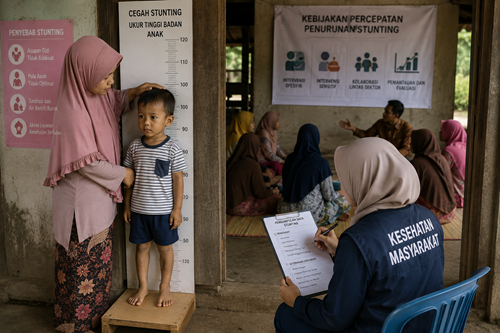
Introduction: Stunting remains a persistent public health challenge in Indonesia, reflecting structural socioeconomic inequalities and uneven policy implementation. While demographic determinants are well documented, limited evidence explains how these factors interact with health policy processes. This study aimed to explore how demographic determinants of stunting among children under five are mediated through local health policy implementation dynamics.
Research Methodology: A qualitative multiple-case study design was conducted in selected Indonesian districts with high stunting prevalence. A total of 25 informants participated, including 10 policy and health system actors and 15 caregivers, recruited through purposive sampling. Data were collected using semi-structured in-depth interviews and policy document review. Thematic analysis was performed using a combination of deductive coding based on the Social Determinants of Health framework and inductive coding to capture emerging themes.
Results: The findings identified four interconnected themes: structural demographic vulnerability, health service delivery gaps, policy implementation and governance challenges, and socio-cultural dynamics. Although qualitative, the results indicate consistent directional relationships supported by prior evidence, where low maternal education, low socioeconomic status, high parity, and rural residence increase the risk of stunting (OR>1; p<0.05). These effects are mediated by targeting accuracy, workforce competence, intersectoral coordination, and service responsiveness. Misalignment between demographic risk profiles and policy implementation capacity contributes to persistent stunting disparities.
Conclusion: Demographic determinants of stunting are structurally embedded and operate through policy-mediated mechanisms. Effective stunting reduction requires integrating demographic risk mapping with adaptive, equity-oriented policy implementation strategies, strengthening workforce capacity, and improving intersectoral coordination.
Downloads
References
Ambikapathi, R., Baye, K., Cavatassi, R., Schneider Lecy, K., Davis, B., & Neufeld, L. M. (2025). Resilient and inclusive rural transformation: Pathways towards improved nutrition. Global Food Security, 46, 100871. https://doi.org/10.1016/j.gfs.2025.100871
Amouzou, A., Barros, A. J. D., Requejo, J., Faye, C., Akseer, N., Bendavid, E., Blumenberg, C., Borghi, J., El Baz, S., Federspiel, F., Ferreira, L. Z., Hazel, E., Heft-Neal, S., Hellwig, F., Liu, L., Maïga, A., Munos, M., Pitt, C., Shawar, Y. R., … Boerma, T. (2025). The 2025 report of the Lancet Countdown to 2030 for women’s, children’s, and adolescents’ health: tracking progress on health and nutrition. The Lancet, 405(10488), 1505–1554. https://doi.org/10.1016/S0140-6736(25)00151-5
Arestoff, F., Djemaï, E., & Koussoubé, E. (2025). Child nutrition: The effect of micro and macro fertility levels at birth. World Development, 196, 107164. https://doi.org/10.1016/j.worlddev.2025.107164
Arqam, M. L., Firdaus, A. A., Atmojo, A. M., Saputri, G. Z., Furizal, Palahuddin, & Sirnopati, R. (2026). Integrating education-based interventions and machine learning for stunting prevention: A case study in East Lombok, Indonesia. Dialogues in Health, 8, 100264. https://doi.org/10.1016/j.dialog.2025.100264
Astuti, S. J. W., Suindyah Dwiningwarni, S., & Atmojo, S. (2025). Modeling environmental interactions and collaborative interventions for childhood stunting: A case from Indonesia. Dialogues in Health, 6, 100206. https://doi.org/10.1016/j.dialog.2025.100206
Azdagaz, F., Zirari, O., & Liouaeddine, M. (2025). Navigating climate change impacts on agricultural productivity, food and human health security in developing countries. Global Transitions, 7, 430–440. https://doi.org/10.1016/j.glt.2025.07.002
Broyles, L. M. T., Pakhtigian, E. L., & Mejia, A. (2026). Monsoon flooding and undernutrition among children in Bangladesh. Journal of the Academy of Nutrition and Dietetics, 156290. https://doi.org/10.1016/j.jand.2026.156290
Dau, L., Barros, P., Cilliers, E. J., Hemsley, B., Martin, M., Lakhanpaul, M., & Smith, M. (2025). Urban density and child health and wellbeing: A scoping review of the literature. Health & Place, 91, 103393. https://doi.org/10.1016/j.healthplace.2024.103393
Garina, L. A., Dewi, M. K., Trusda, S. A. D., Purbaningsih, W., Muflihah, H., Tursina, A., Respati, T., & Rahimah, S. B. (2024). Maternal, Child, and Household Risk Factors for Children with Stunting. The Open Public Health Journal, 17(1). https://doi.org/10.2174/0118749445321448240823112908
Indriyani, R., Murti, B., Anggraini, N. A., & Puspitasari, Y. (2025). Addressing chronic energy deficiency among Indonesian pregnant women: A social cognitive theory perspective. Social Sciences & Humanities Open, 12, 102122. https://doi.org/10.1016/j.ssaho.2025.102122
Juliansen, A., Heriyanto, R. S., Muljono, M. P., Budiputri, C. L., Sagala, Y. D. S., & Octavius, G. S. (2024). Mental health issues and quality of life amongst school-based adolescents in Indonesia. Journal of Medicine, Surgery, and Public Health, 2, 100062. https://doi.org/10.1016/j.glmedi.2024.100062
Krause, B. L. (2024). Networks and knowledge: Women’s empowerment, networks, and health information-seeking behavior in rural Guatemala. Journal of Rural Studies, 105, 103169. https://doi.org/10.1016/j.jrurstud.2023.103169
Kurnia, I. D., Rachmawati, P. D., Arief, Y. S., Krisnana, I., Rithpho, P., & Arifin, H. (2024). Factors associated with infant and young child feeding practices in children aged 6–23 months in Indonesia: A nationwide study. Journal of Pediatric Nursing, 78, 82–88. https://doi.org/10.1016/j.pedn.2024.06.006
Latif, S. A., Adam, A., & Kamaruddin, S. A. (2025). Economic Income as a Cause of Stunting: an Analysis Based on the Perspective of Karl Marx: Literature Review. Jurnal Ilmiah Kesehatan Sandi Husada, 14(1), 1–7. https://doi.org/10.35816/jiskh.v14i1.1231
Lumastari Ajeng Wijayanti, S. A. L. S. D. N. M. Y. (2025). How is Quality in Homecare Services Created? A Qualitative Study of Health Professional Perspectives. Jurnal Kesehatan Masyarakat, 21(2), 485–496. https://doi.org/10.15294/kemas.v21i2.31257
Malau, L. R. E., Khaliqi, M., Yulni, T., Rambe, K. R., Novanda, R. R., & Wibowo, R. P. (2025). Why we waste: A meta-analysis of food waste behavior using the Theory of Planned Behavior (TPB). Sustainable Futures, 10, 101421. https://doi.org/10.1016/j.sftr.2025.101421
Marthalina, M., Joeliaty, J., Yunizar, Y., & Soemaryani, I. (2025). Work-life balance woman working in the government sector. International Journal of Organizational Analysis, 33(9), 3359–3408. https://doi.org/10.1108/IJOA-03-2024-4372
Martopullo, I., Neves, P. A., Baird, S., Liang, M., Keats, E. C., Cherkas, A., Iyer, A., Seshadri, S. R., Woolway, E., Victora, C. G., Sen, G., Drake, J. K., & Bhutta, Z. A. (2024). Understanding progress and challenges in women’s health and wellbeing in exemplar countries: a time-series study identifying positive outliers. The Lancet Global Health, 12(12), e2012–e2023. https://doi.org/10.1016/S2214-109X(24)00364-4
Nambiza, K. S., Neven, A., Kazaura, W. G., Khattak, M. W., & Brijs, K. (2025). Exploring risky riding behaviors and road safety outcomes among motorcycle taxi riders in Dar es Salaam, Tanzania. Transportation Research Interdisciplinary Perspectives, 34, 101743. https://doi.org/10.1016/j.trip.2025.101743
Phulkerd, S., Samsiripong, W., Borazon, E. Q., Teh, W. S., Saptari, A. F., Sameeha, M. J., Fitri, A. A., Trisnasari, S., Farrell, P., Thow, A.-M., Koon Poh, B., Saptari, A. F., Rachmi, C. N., Jusril, H., Fitri, A. A., Trisnasari, S., Wahyuningsih, W., Arifa, Z. I., Utami, E. S., … Swart, R. (2025). A comparative analysis of food retail policy landscape in four Southeast Asian countries. The Lancet Regional Health - Southeast Asia, 43, 100691. https://doi.org/10.1016/j.lansea.2025.100691
Pienaah, C. K. A., Molle, M. N., & Luginaah, I. (2025). The role of child nutrition counselling, gender dynamics, and intra-household feeding decision-making on child dietary diversity in semi-arid northern Ghana. Appetite, 204, 107755. https://doi.org/10.1016/j.appet.2024.107755
Prayitno, G., Zuhriyah, L., Efendi, A., Arifin, S., Rahmawati, Auliah, A., & Subagiyo, A. (2025). Community-powered environmental pathways to reduce stunting: Food security, social capital, and open innovation in semi-urban Indonesia. Environmental Challenges, 21, 101350. https://doi.org/10.1016/j.envc.2025.101350
Rezaeizadeh, G., Mansournia, M. A., Keshtkar, A., Farahani, Z., Zarepour, F., Sharafkhah, M., Kelishadi, R., & Poustchi, H. (2024). Maternal education and its influence on child growth and nutritional status during the first two years of life: a systematic review and meta-analysis. EClinicalMedicine, 71, 102574. https://doi.org/10.1016/j.eclinm.2024.102574
Roba, K. T., Roba, A. A., Hassen, J. Y., Thompson, G., Brewis, A., & Rosinger, A. Y. (2026). Household water insecurity is associated with greater likelihood of early exclusive breastfeeding cessation and diarrhea among children aged 6-59 months in Ethiopia: Data from Haramaya University Health and Demographic Surveillance System. Journal of the Academy of Nutrition and Dietetics, 156303. https://doi.org/10.1016/j.jand.2026.156303
Shanthi, S. D. (2024). Impact of integrated child development scheme on nutritional and health status of children. Children and Youth Services Review, 163, 107792. https://doi.org/10.1016/j.childyouth.2024.107792
Sofiyah, E. S., Suhardono, S., Lee, C.-H., Ridhosari, B., & Koko Suryawan, I. W. (2025). Gendered importance-performance perspective on sanitation resilience programs. Health & Place, 95, 103530. https://doi.org/10.1016/j.healthplace.2025.103530
Son, K., & Kayaoglu, A. (2026). Hidden work-family challenges in the low- and middle-income countries: a systematic review of causes, consequences, and policy responses. World Development, 202, 107349. https://doi.org/10.1016/j.worlddev.2026.107349
Supranoto, Sasmito, L., Indriastuti, S., Prayitno, H., & Sawir, M. (2025). From parallel to partnership governance: Strengthening institutional synergy for stunting reduction in decentralized Indonesia. Social Sciences & Humanities Open, 12, 102051. https://doi.org/10.1016/j.ssaho.2025.102051
Suprapto. (2026). Stunting Policy Implementation in Indonesia: A Primary Health Care Perspective. Jurnal Ilmiah Kesehatan Sandi Husada, 15(1), 347–361. https://doi.org/10.35816/jiksh.v15i1.302
Suprapto, S. (2025). Integrating Public Health and Clinical Care to Improve Population Health Outcomes. Journal Interdisciplinary Health, 1(1), 1–9. https://doi.org/10.61099/jih.v1i1.183
Weeda, L. J. Z., Bradshaw, C. J. A., Judge, M. A., Saraswati, C. M., & Le Souëf, P. N. (2024). How climate change degrades child health: A systematic review and meta-analysis. Science of The Total Environment, 920, 170944. https://doi.org/10.1016/j.scitotenv.2024.170944
Downloads
Published
How to Cite
Issue
Section
Citation Check
License
Copyright (c) 2026 Suprapto Suprapto, Tirta Asprimi Angreani, Amir Hossein Goudarzian

This work is licensed under a Creative Commons Attribution 4.0 International License.
Statement:
The authors retain the copyright of this work and grant Jurnal Ilmiah Kesehatan Sandi Husada the right of first publication. The work is simultaneously licensed under a Creative Commons Attribution 4.0 International License (CC BY 4.0), which permits use, distribution, and reproduction in any medium, provided the original author(s) and the initial publication in this journal are properly credited.
The authors are permitted to copy and redistribute the published version of the work, including posting it to an institutional repository or including it in a book, with acknowledgment of its initial publication in Jurnal Ilmiah Kesehatan Sandi Husada.