Lived psychological experiences of adolescents exposed to bullying: Implications for nursing practice
DOI:
https://doi.org/10.35816/jiksh.v15i2.389Keywords:
bullying, adolescents, lived experiences, interpretative phenomenological analysis, nursing practiceAbstract
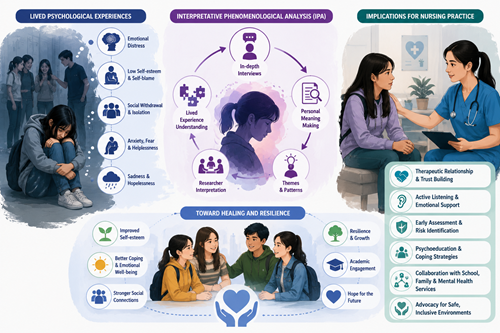
Introduction: Bullying among adolescents is a psychosocial health issue that significantly affects emotional well-being and self-identity development. Although its prevalence and impact have been widely reported, limited research has explored how adolescents interpret and give meaning to their lived experiences of being bullied, particularly within their socio-cultural context. Objective: This study aims to explore the psychological meaning of adolescents lived experiences of bullying using an Interpretative Phenomenological Analysis (IPA) approach.
Research Methodology: This qualitative study employed an IPA approach and was conducted in Makassar, South Sulawesi, Indonesia. Ten adolescents aged 16–19 years were recruited through purposive sampling based on predefined inclusion criteria. Data were collected using in-depth semi-structured interviews and analyzed following IPA procedures. Trustworthiness was ensured through member checking and peer debriefing.
Results: Four main themes emerged: (1) body image and self-identity as sources of social stigma, (2) emotional responses to bullying experiences, (3) diminished self-esteem and emotional vulnerability, and (4) efforts to seek safe spaces and self-recovery strategies. These findings indicate that bullying is internalized as a stigmatizing social experience that shapes adolescents’ identity, emotional regulation, and interpersonal relationships.
Conclusion: This study highlights the importance of culturally sensitive, empathetic, and family-centered nursing interventions that address adolescents’ identity development and emotional resilience. The findings contribute to a deeper understanding of bullying as a meaning-making process and support the development of holistic psychosocial care in adolescent nursing.
Downloads
References
Balluerka, N., Aliri, J., & Go, O. (2023). Association between bullying victimization , anxiety and depression in childhood and adolescence : The mediating effect of self-esteem. Revista de Psicodidactica, 28, 26–34. https://doi.org/10.1016/j.psicoe.2022.11.001
Bernasco, E. L. (2022). Peer Victimization, Internalizing Problems, and the Buffering Role of Friendship Quality : Disaggregating Between- and Within-Person Associations. Journal of Youth and Adolescence, 1653–1666. https://doi.org/10.1007/s10964-022-01619-z
Biswas, T., Scott, J. G., Munir, K., Thomas, H. J., Huda, M. M., Hasan, M., David, T., Vries, D., Baxter, J., & Mamun, A. A. (2020). EClinicalMedicine Global variation in the prevalence of bullying victimization amongst adolescents : Role of peer and parental supports. EClinicalMedicine, 20, 100276. https://doi.org/10.1016/j.eclinm.2020.100276
Compas, B. E., Jaser, S. S., Bettis, A. H., Watson, K. H., Gruhn, M., Dunbar, J. P., Williams, E., & Thigpen, J. C. (2020). Coping, Emotion Regulation and Psychopathology in Childhood and Adolescence: A Meta-Analysis and Narrative Review. Psychol Bull, 143(9), 939–991. https://doi.org/10.1037/bul0000110
Cosma A, Walsh SD, Chester KL, Callaghan M, Molcho M, Craig W, P. W. (2020). Bullying victimization: time trends and the overlap between traditional and cyberbullying across countries in Europe and North America. Int J Public Health, 65(1), 75–85. https://doi.org/10.1007/s00038-019-01320-2
Erskine, H. E., Maravilla, J. C., Fine, S. L., Ramaiya, A., & Li, M. (2025). Bullying victimization and perpetration and the association with mental disorders among adolescents in Kenya, Indonesia, and Vietnam : Findings from the National Adolescent Mental Health Surveys. Child and Adolescent Psychiatry and Mental Health, 19(Suppl 1), 1–13. https://doi.org/10.1186/s13034-025-00922-4
Feng, et al. (2023). Peer victimization and adolescent problematic social media use: The stress-buffering role of family support. Addictive Behaviors. https://doi.org/10.1016/j.addbeh.2023.107721
Feng, Y., Zhang, S., & Liao, X. (2024). Association between bullying victimization and mental health problems among Chinese left- behind children : a cross-sectional study from the adolescent mental health promotion cohort. Front. Psychiatry, November, 1–15. https://doi.org/10.3389/fpsyt.2024.1440821
Gaffney, H., Ttofi, M. M., & Farrington, D. P. (2021). Effectiveness of school ‐ based programs to reduce bullying perpetration and victimization : An updated systematic review and meta ‐ analysis. Aggression and Violent Behavior. https://doi.org/10.1002/cl2.1143
Giuliani, A., Petruccelli, I., & Urso, G. D. (2025). Longitudinal Evidence on Peer Victimization and Persistent Mental Health Outcomes in Youth : A Systematic Review. Behavioral Sciences, 1–24. https://doi.org/10.3390/bs15121734
Han, Z., Ye, Z., & Zhong, B. (2025). School bullying and mental health among adolescents : a narrative review. Transl Pediatr, 14(3), 463–472. https://doi.org/10.21037/tp-2024-512
Hidayati, L. N., & Amalia, R. (2021). Psychological Impacts On Adolescent Victims Of Bullying : A Phenomenology Study. Media Kepearwatan Indonesia, 18. https://doi.org/10.26714/mki.4.3.2021.201-207
Horton, P., & Lyng, S. T. (2022). Qualitative Methods in School Bullying and Cyberbullying Research: An Introduction to the Special Issue. In International Journal of Bullying Prevention (Vol. 4, Issue 3, pp. 175–179). Springer Nature. hhttps://doi.org/10.1007/s42380-022-00139-5
Jonathan A. Smith, Flowers, P., & Larkin, M. (2021). Interpretative Phenomenological Analysis: Theory, Method and Research (2nd ed.). SAGE Publications.
Kementerian Pemberdayaan Perempuan dan Perlindungan Anak Republik Indonesia. (2022). Profil anak Indonesia 2022. KemenPPPA. https://www.kemenpppa.go.id/buku/profil-anak-indonesia-2022
Luthar, S. S., Crossman, E. J., & Small, P. J. (2020). Resilience and adversity. Handbook of Child Psychology and Developmental Science. https://doi.org/https://psycnet.apa.org/doi/10.1002/9781118963418.childpsy307
Marcos, A., & Esteca, N. (2025). Adolescentes Sobre Bullying E Cyberbullying : Rapid Review. New Trends in Qualitative Research. https://doi.org/10.36367/ntqr.21.1.2025.e1191
Martínez, M., Damme, K. S., Vargas, T., Yang, B., Rompilla, D. J., Stephens, J., Qu, Y., Mittal, V. A., & Haase, C. M. (2025). Longitudinal study of peer victimization, social support, and mental health during early adolescence. Psychol Med, 54(9), 1940–1955. https://doi.org/10.1017/S0033291724000035
Masten, A. S. (2023). Resilience in development : Pathways to multisystem integration. Development and Psychopathology, 2103–2112. https://doi.org/10.1017/S0954579423001293
Nollaig Frost. (2021). Qualitative Research Methods in Psychology: Combining Core Approaches (2nd ed.). McGraw-Hill.
Nursing & Midwifery Council. (2021). The code: Professional standards of practice and behaviour for nurses, midwives and nursing associates. https://www.nmc.org.uk/standards/code/
Olweus. (2013). Bullying at school: What we know and what we can do. Wiley-Blackwell.
Oram, S., Fisher, H. L., Minnis, H., Seedat, S., Walby, S., Hegarty, K., Rouf, K., Angénieux, C., Callard, F., Chandra, P. S., Fazel, S., Garcia-Moreno, C., Henderson, M., Howarth, E., Macmillan, H. L., & Murray, L. K. (2022). The Lancet Psychiatry Commissions The Lancet Psychiatry Commission on intimate partner violence and mental health : advancing mental health services, research, and policy. The Lancet Psychiatry Commissions. https://doi.org/10.1016/S2215-0366(22)00008-6
Permata, I. (2022). Dampak Bullying Terhadap Perilaku Remaja ; Studi Kasus pada Pelajar SMA Negri Palembang Bullying’s Effect on Adolescent Behavior ; Case Study on Palembang State High School Students. Intervensi, Jurnal Jisp, Pembangunan, 3(1), 10–16. https://doi.org/10.30596/jisp.v3i1.8637
Perret, L. C., … et al. (2021). Perceived friend support buffers against symptoms of depression following peer victimization. Journal of Affective Disorders, 287(106–112). https://doi.org/10.1016/j.jad.2021.04.078
Puhl RM, L. L. (2020). Weight Stigma in Youth: Prevalence, Consequences, and Considerations for Clinical Practice. Curr Obes Rep. 2020. Curr Obes Rep., 9(4), 402–411. https://doi.org/10.1007/s13679-020-00408-8
Schacter, H. L., Hoffman, A. J., & Ehrhardt, A. (2023). Peer victimization, schooling format, and adolescent internalizing symptoms during the COVID-19 pandemic : Between- and within-person associations across ninth grade. Development and Psychopathology, 823–837. https://doi.org/10.1017/S0954579422000074
Sekar, D. A. C., & Fauzia, N. (2023). Peer Social Support for Adolescent Victims of Bullying. International Journal of Social Science Research and Review, 6(6), 614-628. https://doi.org/10.47814/ijssrr.v6i6.1377
Simsek, A., Murat, M., Ali, M., Er, S., & Kose, S. (2025). Exploring the impact of peer victimization on self ‑ esteem in adolescents with type 1 diabetes : the power of psychological resilience. European Journal of Pediatrics. https://doi.org/10.1007/s00431-025-06203-8
UNESCO. (2019). Behind the numbers : Ending school violence and bullying. United Nations Educational, Scientific, and Cultural Organization. https://doi.org/10.54675/TRVR4270
Wang Y, Wang T, Wang J, Zeng L, Li G, Li J, Zhou Y, W. Y. (2024). The School Bullying Victimization in Adolescents With Non-Suicidal Self-Injury: The Role of Coping Strategies and Emotion Regulation. Stress Health. https://doi.org/10.1002/smi.3506
World Health Organization. (2022). Improving the mental and brain health of children and adolescents. World Health Organization. https://www.who.int/activities/improving-the-mental-and-brain-health-of-children-and-adolescents
Yang, W., Hu, D., & Guo, Y. (2024). The relationship between school bullying victimization and social mindfulness in middle school students: a chain-mediated model of self-concept clarity and cognitive reappraisal. Frontiers in Pediatrics, August, 1–8. https://doi.org/10.3389/fpsyg.2024.1388301
Zaen, N. A., Nuha, R. U., & Veibiani, N. A. (2022). Meta-Analysis : The Effect of Bullying on Adolescents' Mental Health and Depression. Journal of Epidemiology and Public Health, 07, 104–119. https://doi.org/10.26911/jepublichealth.2022.07.01.09.
Zhang, Y. (2023). Emotional Intelligence and School Bullying Victimization in Children and Youth Students : A Meta-Analysis. International Journal of Environmental Research and Public Health. https://doi.org/10.3390/ijerph20064746
Downloads
Published
How to Cite
Issue
Section
Citation Check
License
Copyright (c) 2026 Merysambo Merysambo, Kristia Novia, Triwira Siagian, Ria Setia Sari, Nikodemus Sili Beda

This work is licensed under a Creative Commons Attribution 4.0 International License.
Statement:
The authors retain the copyright of this work and grant Jurnal Ilmiah Kesehatan Sandi Husada the right of first publication. The work is simultaneously licensed under a Creative Commons Attribution 4.0 International License (CC BY 4.0), which permits use, distribution, and reproduction in any medium, provided the original author(s) and the initial publication in this journal are properly credited.
The authors are permitted to copy and redistribute the published version of the work, including posting it to an institutional repository or including it in a book, with acknowledgment of its initial publication in Jurnal Ilmiah Kesehatan Sandi Husada.