Mental health and breastfeeding behavior in early postpartum mothers: A cross-sectional study
DOI:
https://doi.org/10.35816/jiksh.v15i2.377Keywords:
breastfeeding, mental health, postpartum period, maternal behavior, lactationAbstract
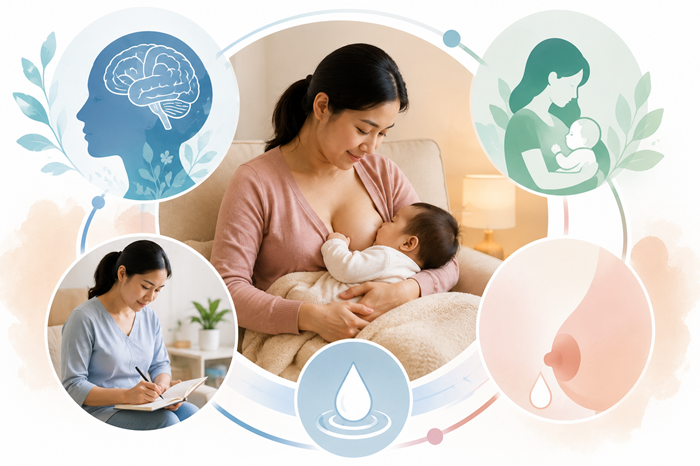
Introduction: Breastfeeding in the early postpartum period is critical for maternal–infant health, yet maternal psychological conditions may influence breastfeeding practices. This study aimed to examine the association between maternal mental health status and breastfeeding behavior among early postpartum mothers at PKU Muhammadiyah Delanggu Hospital, Indonesia.
Research Methodology: A quantitative descriptive–analytic study with a cross-sectional design was conducted during June–July 2023. A total of 65 early postpartum mothers were recruited using accidental (convenience) sampling. Maternal mental health was assessed using the Depression Anxiety Stress Scale-21 (DASS-21), while breastfeeding behavior was measured using a validated questionnaire and LATCH observation. Data were analyzed using univariate statistics and the chi-square test with a significance level of 0.05.
Results: Overall, 50.8% of mothers had good mental health, and 58.5% demonstrated positive breastfeeding behavior. A significant association was found between maternal mental health and breastfeeding behavior (χ² test, p = 0.018). Mothers with good mental health were more likely to exhibit positive breastfeeding behavior compared with those with poorer mental health (36.9% vs 21.5%). Conversely, negative breastfeeding behavior was higher among mothers with poorer mental health (27.7% vs 13.8%).
Conclusion: Maternal mental health is significantly associated with breastfeeding behavior in the early postpartum period. Integrating routine mental health screening into postpartum care may improve breastfeeding outcomes and support maternal well-being.
Downloads
References
Chang, Y.-S., Li, K. M. C., Chien, L.-Y., Lee, E. Y., Hong, S. A., & Coca, K. P. (2023). Associations between breastfeeding intention, breastfeeding practices, and post‐natal depression during the COVID‐19 pandemic: A multi‐country cross‐sectional study. Maternal & Child Nutrition, 19(1), e13450. https://doi.org/10.1111/mcn.13450
Dagla, M., Dagla, C., Theodoropoulou, I., Kontiza, E., Tsolaridou, E., & Antoniou, E. (2021). The Association of Breastfeeding Difficulties at the 6th week Postpartum with Maternal Psychological Well-being and Other Perinatal Factors: a Greek Retrospective Longitudinal Study. Materia Socio Medica, 33(2), 109. https://doi.org/10.5455/msm.2021.33.109-113
Garthus-Niegel, S., Radoš, S. N., & Horsch, A. (2022). Perinatal Depression and Beyond—Implications for Research Design and Clinical Management. JAMA Network Open, 5(6), e2218978. https://doi.org/10.1001/jamanetworkopen.2022.18978
Gianni Lorella Maria, Bettinelli Enrica Maria, Manfra Priscilla, Soreentino Gabriele, Bezzee Elena, Plevani Laura, Cavallaro Giacomo, Raffaeli Ganny, Crippa Letizia Beatrice, Colombo Lorenzo, Morniroli Daniela, Liotto Nadia, Roggero Paola, Villamor Eduardo, Marchisio Paola, & Mosca Fabio. (2019). Breastfeeding Difficulties and Risk for Early Breastfeeding Cessation. Nutrients, 11(2266), 1–10.
Gila-Díaz, A., Carrillo, G. H., de Pablo, Á. L. L., Arribas, S. M., & Ramiro-Cortijo, D. (2020). Association between maternal postpartum depression, stress, optimism, and breastfeeding pattern in the first six months. International Journal of Environmental Research and Public Health, 17(19), 1–13. https://doi.org/10.3390/ijerph17197153
Hastuti, P., & Tri Wijayanti, I. (2017). Analisis Deskriptif Faktor yang Mempengaruhi Pengeluaran ASI pada Ibu Nifas di Desa Sumber Kecamatan Sumber Kabupaten Rembang. Urecol University Research Colloquium, 223–232.
Ho, H. M. Y., Fan, H. S. L., Hu, G. H., Nagesh, N., Ip, H. L., Leung, E. T. Y., Choi, E. P. H., & Lok, K. Y. W. (2024). Effectiveness of layperson-based interventions in promoting exclusive breastfeeding: A systematic review and meta-analysis. International Journal of Nursing Studies, 160, 104894. https://doi.org/10.1016/j.ijnurstu.2024.104894
Huang, J., Yang, X., Liang, X., Chen, S., Sun, Y., Mok, G. S., Li, S., Wang, Y., & Tan, T. (2026). Anatomy-guided prompting with cross-modal self-alignment for whole-body PET-CT breast cancer segmentation. Medical Image Analysis, 110, 103956. https://doi.org/10.1016/j.media.2026.103956
Huang, J. Z., Chen, C. N., Lee, C. P., Kao, C. H., Hsu, H. C., & Chou, A. K. (2022). Evaluation of the Effects of Skin-to-Skin Contact on Newborn Sucking, and Breastfeeding Abilities: A Quasi-Experimental Study Design. Nutrients, 14(9). https://doi.org/10.3390/nu14091846
Huang, R., Wan, Y., Yao, X., Wang, H., Cai, C., Xu, Y., & Jiang, H. (2022). Predictive factors of exclusive breastfeeding attrition at Week 6 post-partum among mothers of preterm infants based on the theory of planned behaviour. Maternal & Child Nutrition, n/a(n/a), e13470. https://doi.org/https://doi.org/10.1111/mcn.13470
Isiguzo, C., Mendez, D. D., Demirci, J. R., Youk, A., Mendez, G., Davis, E. M., & Documet, P. (2022). Stress, social support, and racial differences: Dominant drivers of exclusive breastfeeding. Maternal & Child Nutrition, n/a(n/a), e13459. https://doi.org/https://doi.org/10.1111/mcn.13459
Jalal, M., Dolatian, M., Mahmoodi, Z., & Aliyari, R. (2017). The relationship between psychological factors and maternal social support to breastfeeding process. Electronic Physician, 9(1), 3561–3569. https://doi.org/10.19082/3561
Jiang, Q., Zhang, E., Cohen, N., Ohtori, M., Zhu, S., Guo, Y., Johnstone, H. F., Dill, S. E., Zhou, H., & Rozelle, S. D. (2022). Postnatal mental health, breastfeeding beliefs, and breastfeeding practices in rural China. International Breastfeeding Journal, 17(1), 1–9. https://doi.org/10.1186/s13006-022-00504-6
Kementerian Kesehatan Republik Indonesia. (2022). Profil Kesehatan Indonesia Tahun 2021. P2PTM Kementerian Kesehatan Republik Indonesia. In F. Sibuea, B. Hardhana, & W. Widiantini (Eds.), IT - Information Technology (Vol. 48, Issue 1). Kementerian Kesehatan Republik Indonesia.
Kossakowska, K., & Bielawska-Batorowicz, E. (2022). Postpartum Depressive Symptoms and Their Selected Psychological Predictors in Breast-, Mixed and Formula-Feeding Mothers. Frontiers in Psychiatry, 13(February), 1–12. https://doi.org/10.3389/fpsyt.2022.813469
Lail, N. H. (2019). Asuhan Kebidanan Komprehensif. In LPU-UNAS. LPU-UNAS.
Maria, C., Helena, M., & Amorim, C. (2022). LATCH as a systematic tool for assessment of the breastfeeding technique in maternity. SCielo, 35(03), 1–9. https://doi.org/(https://orcid.org/0000-0002-6243-6497
Mehrpisheh, S., Memarian, A., Ameri, M., & Saberi Isfeedvajani, M. (2020). The Importance of Breastfeeding Based on Islamic Rules and Qur’an. Hospital Practices and Research, 5(2), 37–41. https://doi.org/10.34172/hpr.2020.08
Mufdlilah, Retnaningsih, D., & Fatmawati, V. (2022). Kursi Oksitosin Ibu Menyusui (KORSIMU) (1st ed.). Deepublish.
Rahman, A., Hafeez, A., Bilal, R., Sikander, S., Malik, A., Minhas, F., Tomenson, B., & Creed, F. (2016). The impact of perinatal depression on exclusive breastfeeding: a cohort study. Maternal & Child Nutrition, 12(3), 452–462. https://doi.org/10.1111/mcn.12170
Sha, T., Gao, X., Chen, C., Li, L., Cheng, G., Wu, X., Tian, Q., Yang, F., He, Q., & Yan, Y. (2019). A prospective study of maternal postnatal depressive symptoms with infant-feeding practices in a Chinese birth cohort. BMC Pregnancy and Childbirth, 19(1), 1–9. https://doi.org/10.1186/s12884-019-2559-1
Shah, M. H., Roshan, R., Parikh, T., Sathe, S., Vaidya, U., & Pandit, A. (2021). LATCH Score at Discharge: A Predictor of Weight Gain and Exclusive Breastfeeding at 6 Weeks in Term Healthy Babies. Journal of Pediatric Gastroenterology and Nutrition, 72(2), e48–e52. https://doi.org/10.1097/MPG.0000000000002927
Sugiyono, S. (2021). Statistika Untuk Penelitian (31st ed.). Alfabeta.
Word Health Organization. (2018). 3 in 5 babies not breastfed in the first hour of life. World Health Organization.
Downloads
Published
How to Cite
Issue
Section
Citation Check
License
Copyright (c) 2026 Anita Dewi Lieskusumastuti, Mudfdlilah, Sri Ratna Ningsih

This work is licensed under a Creative Commons Attribution 4.0 International License.
Statement:
The authors retain the copyright of this work and grant Jurnal Ilmiah Kesehatan Sandi Husada the right of first publication. The work is simultaneously licensed under a Creative Commons Attribution 4.0 International License (CC BY 4.0), which permits use, distribution, and reproduction in any medium, provided the original author(s) and the initial publication in this journal are properly credited.
The authors are permitted to copy and redistribute the published version of the work, including posting it to an institutional repository or including it in a book, with acknowledgment of its initial publication in Jurnal Ilmiah Kesehatan Sandi Husada.