
Knowledge, Attitudes, and Motivation Associated with Hypertension Self-Care Adherence Among Older Adults: A Cross-Sectional Study
DOI:
https://doi.org/10.61099/junedik.v3i3.471Keywords:
Aged, Health Knowledge, Attitudes, Practice, Hypertension, Medication Adherence, Self CareAbstract
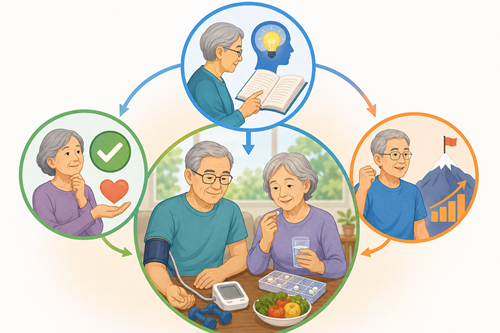
Introduction: Hypertension remains one of the leading chronic conditions affecting older adults and requires sustained self-care adherence to prevent cardiovascular and renal complications. Multiple behavioral factors influence adherence, yet evidence regarding the contribution of knowledge, attitudes, and motivation among Indonesian older adults remains limited. This study aimed to examine the associations between knowledge, attitudes, motivation, and self-care adherence among older adults with hypertension in Palu, Indonesia.
Methods: A community-based cross-sectional study was conducted between May and June 2026 involving 72 older adults with hypertension selected through accidental sampling from a population of 250 eligible patients. Data were collected using structured questionnaires assessing knowledge, attitudes, motivation, and self-care adherence. Descriptive statistics summarized participant characteristics, while Chi-square tests and odds ratios (ORs) with 95% confidence intervals (CIs) were used to evaluate associations. Statistical significance was established at p<0.05.
Results: Most participants demonstrated good knowledge (59.7%), positive attitudes (62.5%), high motivation (66.7%), and adherence to hypertension self-care (63.9%). Good knowledge was significantly associated with greater adherence (OR=9.77; 95% CI: 3.05–31.35; p<0.001). Participants with positive attitudes were more likely to adhere to recommended self-care practices (OR=12.89; 95% CI: 3.85–43.17; p<0.001). High motivation showed the strongest association with adherence (OR=35.00; 95% CI: 8.36–146.59; p<0.001).
Conclusion: Knowledge, positive attitudes, and motivation were significantly associated with self-care adherence among older adults with hypertension. Strengthening patient education, motivational counseling, family engagement, and continuous follow-up may improve long-term adherence and contribute to better hypertension management in primary healthcare settings
Downloads
References
Alvarez, C. et al. (2022) ‘Challenges with hypertension self-care among survivors of adverse childhood experiences’, SSM - Qualitative Research in Health, 2, p. 100065. doi: https://doi.org/10.1016/j.ssmqr.2022.100065.
Andala, S. et al. (2024) ‘Knowledge and acceptance associated with medication adherence among hypertension individuals in Aceh province, Indonesia’, Heliyon, 10(7), p. e29303. doi: https://doi.org/10.1016/j.heliyon.2024.e29303.
Booker, S., Herr, K. and Tripp-Reimer, T. (2021) ‘Black American older adults’ motivation to engage in osteoarthritis treatment recommendations for pain self-management: A mixed methods study’, International Journal of Nursing Studies, 116, p. 103510. doi: https://doi.org/10.1016/j.ijnurstu.2019.103510.
Dong, H., Zhang, D. and Wang, T. (2024) ‘The effects of Solution-Focused Brief Therapy on self-care and mental health among older adults at risk of coronary heart disease: A randomized controlled trial’, Geriatric Nursing, 57, pp. 11–16. doi: https://doi.org/10.1016/j.gerinurse.2024.02.029.
Durukan, B. N. et al. (2024) ‘Reliability and validity of the Turkish version of the Self-care of Hypertension Inventory Version 3.0 in adults with hypertension’, Journal of Vascular Nursing, 42(2), pp. 131–137. doi: https://doi.org/10.1016/j.jvn.2024.02.006.
Ferdinand, D. P. et al. (2023) ‘TEXT MY BP MEDS NOLA: A pilot study of text-messaging and social support to increase hypertension medication adherence’, American Heart Journal Plus: Cardiology Research and Practice, 26, p. 100253. doi: https://doi.org/10.1016/j.ahjo.2023.100253.
Green, D. L. et al. (2023) ‘The role of multidimensional poverty in antibiotic misuse: a mixed-methods study of self-medication and non-adherence in Kenya, Tanzania, and Uganda’, The Lancet Global Health, 11(1), pp. e59–e68. doi: https://doi.org/10.1016/S2214-109X(22)00423-5.
He, Z. et al. (2022) ‘A Machine-Learning Based Approach for Predicting Older Adults’ Adherence to Technology-Based Cognitive Training’, Information Processing & Management, 59(5), p. 103034. doi: https://doi.org/10.1016/j.ipm.2022.103034.
Kgasi, M., Chimbo, B. and Motsi, L. (2023) ‘mHealth Self-Monitoring Model for Medicine Adherence of Patients With Diabetes in Resource-Limited Countries: Structural Equation Modeling Approach’, JMIR Formative Research, 7. doi: https://doi.org/10.2196/49407.
Kwakye, A. O. et al. (2024) ‘Factors influencing medication adherence in co-morbid hypertension and diabetes patients: A scoping review’, Exploratory Research in Clinical and Social Pharmacy, 13, p. 100426. doi: https://doi.org/10.1016/j.rcsop.2024.100426.
Lawless, M. T. et al. (2021) ‘Theories of self-care and self-management of long-term conditions by community-dwelling older adults: A systematic review and meta-ethnography’, Social Science & Medicine, 287, p. 114393. doi: https://doi.org/10.1016/j.socscimed.2021.114393.
Lee, E. and Choi, M. (2024) ‘Factors associated with medication adherence among older adults with multimorbidity: A culture perspective’, Geriatric Nursing, 55, pp. 297–303. doi: https://doi.org/10.1016/j.gerinurse.2023.11.018.
Liska, J. et al. (2024) ‘Mapping the Cardiometabolic Patient Experience and Self-Care Behaviors to Inform Design, Implementation, and Persistent Use of Digital Health Care Solutions: Mixed Methods Study’, JMIR Formative Research, 8, p. e43683. doi: https://doi.org/10.2196/43683.
Lu, Q. et al. (2024) ‘Factors Influencing the Self-Management Stages of Older Patients With Chronic Pain: A Cross-Sectional Study’, Pain Management Nursing, 25(6), pp. e411–e419. doi: https://doi.org/10.1016/j.pmn.2024.07.012.
Morrow, D. and Chin, J. (2022) ‘Chapter Five - A process-knowledge approach to supporting self-care among older adults’, in Federmeier, K. D. and Payne, B. R. B. T.-P. of L. and M. (eds) Cognitive Aging. Academic Press, pp. 165–191. doi: https://doi.org/10.1016/bs.plm.2022.07.003.
Papus, M. et al. (2022) ‘Motivational interviewing to support medication adherence in adults with chronic conditions: Systematic review of randomized controlled trials’, Patient Education and Counseling, 105(11), pp. 3186–3203. doi: https://doi.org/10.1016/j.pec.2022.06.013.
Siette, J. et al. (2024) ‘A Pilot Study of BRAIN BOOTCAMP, a Low-Intensity Intervention on Diet, Exercise, Cognitive Activity, and Social Interaction to Improve Older Adults’ Dementia Risk Scores’, The Journal of Prevention of Alzheimer’s Disease, 11(5), pp. 1500–1512. doi: https://doi.org/10.14283/jpad.2024.104.
Spitz, J. A. et al. (2024) ‘Public Health Messaging to Older Adults About Hypertension’, Clinics in Geriatric Medicine. doi: https://doi.org/10.1016/j.cger.2024.04.006.
Srisodsaluk, P. et al. (2023) ‘An application of Organismic Integration Theory to enhance basic psychological needs satisfaction and motivation for rehabilitation in older stroke survivors: A randomized controlled trial study’, Geriatric Nursing, 54, pp. 1–7. doi: https://doi.org/10.1016/j.gerinurse.2023.08.008.
Tyson, C. C. et al. (2023) ‘Self-Perceived Barriers and Facilitators to Dietary Approaches to Stop Hypertension Diet Adherence Among Black Americans With Chronic Kidney Disease: A Qualitative Study’, Journal of Renal Nutrition, 33(1), pp. 59–68. doi: https://doi.org/10.1053/j.jrn.2022.05.002.
Unni, E., Han, J. and Dillon, P. (2022) ‘A Theory of Planned Behavior informed factorial survey of New York community pharmacists to determine their intentions to monitor antihypertensive medication adherence among older adults’, Journal of the American Pharmacists Association, 62(5), pp. 1572–1580. doi: https://doi.org/10.1016/j.japh.2022.03.018.
Wong, A. K. C. et al. (2024) ‘Effectiveness of the Support From Community Health Workers and Health Care Professionals on the Sustained Use of Wearable Monitoring Devices Among Community-Dwelling Older Adults: Feasibility Randomized Controlled Trial’, Journal of Medical Internet Research, 26. doi: https://doi.org/10.2196/52435.
Yang, C. et al. (2022) ‘Effects of a nurse-led medication self-management intervention on medication adherence and health outcomes in older people with multimorbidity: A randomised controlled trial’, International Journal of Nursing Studies, 134, p. 104314. doi: https://doi.org/10.1016/j.ijnurstu.2022.104314.
Yang, C., Lee, D. T. F. and Chair, S. Y. (2023) ‘Validation and adaption of an Information-Motivation-Behavioral Skills model of medication adherence in older patients with multimorbidity’, Patient Education and Counseling, 113, p. 107756. doi: https://doi.org/10.1016/j.pec.2023.107756.
Zhou, Z. et al. (2024) ‘A scoping review of factors associated with self-management in young adults with stroke’, Patient Education and Counseling, 125, p. 108308. doi: https://doi.org/10.1016/j.pec.2024.108308.
Additional Files
Published
How to Cite
Issue
Section
Citation Check
License
Statement:
The authors retain the copyright of this work and grant Jurnal Edukasi Ilmiah Kesehatan the right of first publication. The work is simultaneously licensed under Creative Commons Attribution 4.0 International License (CC BY 4.0), which permits use, distribution, and reproduction in any medium, provided the original author(s) and the initial publication in this journal are properly credited. The authors are permitted to copy and redistribute the published version of the work, including posting it to an institutional repository or including it in a book, with acknowledgment of its initial publication in Jurnal Edukasi Ilmiah Kesehatan.





