
Associations of indoor smoking and household environmental conditions with tuberculosis occurrence in south sorong, indonesia
DOI:
https://doi.org/10.61099/jih.v2i4.559Keywords:
environmental health, humidity, smoking, temperature, tuberculosisAbstract
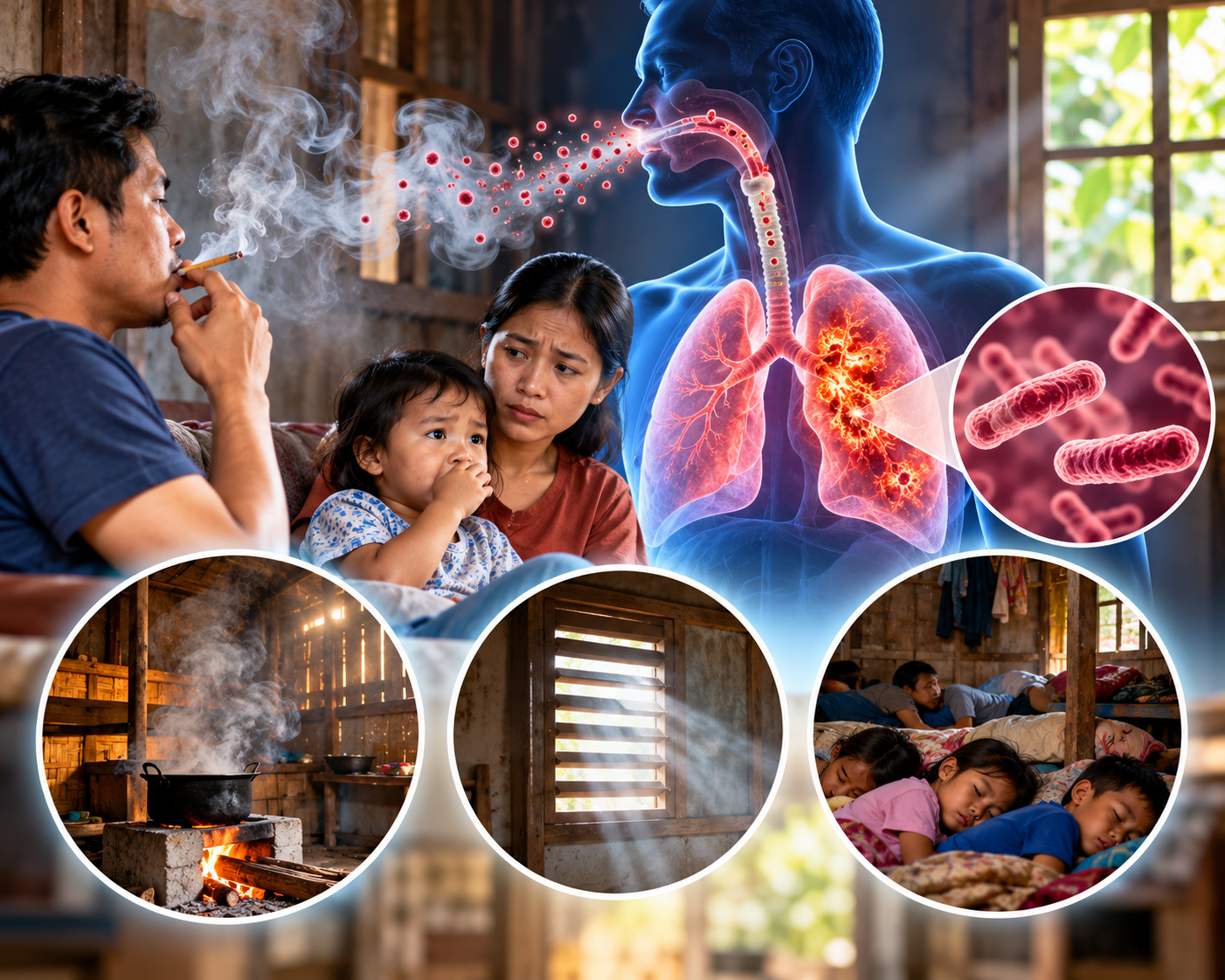
Introduction: Tuberculosis remains a major public health concern, particularly in communities where household behaviors and environmental conditions may facilitate transmission. Indoor smoking can impair respiratory defenses and reduce indoor air quality, while inappropriate temperature and humidity may create household environments that are less favorable for respiratory health. This study examined the associations of indoor smoking, household temperature, and humidity with tuberculosis occurrence in South Sorong, Indonesia.
Research Methodology: A quantitative observational analytic study with a cross-sectional design was conducted among 79 respondents in the working area of Fkour Public Health Center, South Sorong Regency. Data were collected using questionnaires, a tuberculosis screening form, and direct measurements of indoor temperature and humidity using a thermohygrometer. Descriptive and bivariate analyses were performed using Chi-square-based tests with a significance level of 0.05.
Results: Tuberculosis was identified in 17 of 79 respondents (21.5%). TB occurred in 65.2% of respondents with poor indoor smoking practices compared with 3.6% among those with good practices. TB was also identified in 57.7% of respondents living in houses with non-compliant temperatures compared with 3.8% in compliant houses, and in 52.2% of respondents living in houses with non-compliant humidity compared with 8.9% in compliant houses. Indoor smoking, temperature, and humidity were significantly associated with tuberculosis occurrence (all p<0.001).
Conclusion: Indoor smoking and unfavorable household environmental conditions were significantly associated with tuberculosis occurrence. Strengthening smoke-free home policies, household environmental monitoring, contact investigation, and timely diagnostic follow-up may support community-based tuberculosis prevention and control.
Downloads
References
1. Garcia I, Giovanini L, López L. Predictive modeling and spatiotemporal analysis of TB in Argentina: Advancing control efforts through machine learning. Public Health. 2026;252:106151. doi:https://doi.org/10.1016/j.puhe.2026.106151
2. Goudarzi G, Reshadatian N. The study of effective factors in sick building syndrome related to fungi and its control methods. Results Eng. 2024;23:102703. doi:https://doi.org/10.1016/j.rineng.2024.102703
3. Goyal M, Santhanam S. Epidemiology of rheumatic diseases in tropical populations. Best Pract Res Clin Rheumatol. 2025;39(2):102059. doi:https://doi.org/10.1016/j.berh.2025.102059
4. Granda-Orive JI de, Jiménez-Ruiz CA, Unzueta IG, et al. Effects on Health of Passive Smoking and Vape on Terraces in the COVID-19 Pandemic: A Review. Open Respir Arch. 2022;4(4):100204. doi:https://doi.org/10.1016/j.opresp.2022.100204
5. Huang K, Hu C-Y, Yang X-Y, et al. Contributions of ambient temperature and relative humidity to the risk of tuberculosis admissions: A multicity study in Central China. Sci Total Environ. 2022;838:156272. doi:https://doi.org/10.1016/j.scitotenv.2022.156272
6. Khan SA, Manjunatha MC, Jayaraj BS, et al. Assessing the hotspot analysis and spatial clustering for pulmonary tuberculosis from 2019 to 2023 in Mysuru district, India. Clin Epidemiol Glob Heal. 2026;37:102272. doi:https://doi.org/10.1016/j.cegh.2025.102272
7. Khandelwal P, Yadav N, Saini A, Sangwan NS. A new paradigm in tuberculosis diagnostics: Biosensing advances for early detection of Mycobacterium tuberculosis. Anal Biochem. 2026;713:116088. doi:https://doi.org/10.1016/j.ab.2026.116088
8. Kharwadkar S, Attanayake V, Duncan J, Navaratne N, Benson J. The impact of climate change on the risk factors for tuberculosis: A systematic review. Environ Res. 2022;212:113436. doi:https://doi.org/10.1016/j.envres.2022.113436
9. Lemos J, de Souza VB, Lima TM, Gaspar PD. OSH Guardian: An Industry 5.0 approach for individual environmental risk assessment based on the worker’s health profile. Saf Sci. 2026;203:107311. doi:https://doi.org/10.1016/j.ssci.2026.107311
10. Li J-X, Luan Q, Li B, et al. Outdoor environmental exposome and the burden of tuberculosis: Findings from nearly two million adults in northwestern China. J Hazard Mater. 2023;459:132222. doi:https://doi.org/10.1016/j.jhazmat.2023.132222
11. Liao Y, Men D, Li H, Li Y, Liu Y. Street-level ambient fine particulate matter and tuberculosis: A machine learning and Bayesian spatiotemporal analysis. Environ Pollut. 2026;395:127811. doi:https://doi.org/10.1016/j.envpol.2026.127811
12. Liu Q, Zhou L, Yang W, Liu M, Liu J. Associations between environmental exposure, lifestyle, and the risk of respiratory infections among 67890 adults: A population-based cohort analysis using UK Biobank data. Glob Heal Res Policy. 2026;11(1):43-50. doi:https://doi.org/10.1016/j.ghrp.2026.04.001
13. Lu J-W, Mao J-J, Zhang R-R, et al. Association between long-term exposure to ambient air pollutants and the risk of tuberculosis: A time-series study in Nantong, China. Heliyon. 2023;9(6):e17347. doi:https://doi.org/10.1016/j.heliyon.2023.e17347
14. Perwitasari DA, Faridah IN, Casnan C, et al. Dynamic system of tuberculosis elimination modelling in Indonesia: A study in Kuningan, West Java, Indonesia. Informatics Med Unlocked. 2025;59:101714. doi:https://doi.org/10.1016/j.imu.2025.101714
15. Prapamontol T, Norbäck D, Thongjan N, et al. Respiratory infections among junior high school students in upper northern Thailand: The role of building dampness and mould, biomass burning and outdoor relative air humidity (RH). Environ Res. 2023;231:116065. doi:https://doi.org/10.1016/j.envres.2023.116065
16. Roy Choudhury A, Singh N, Chinthala S, et al. Environmental health hazards attributed to deteriorated indoor air quality caused by inferior construction practices. Environ Sci Atmos. 2025;5(9):941-961. doi:https://doi.org/10.1039/d5ea00027k
17. Saunders MJ, Boccia D, Khan PY, et al. Climate change and tuberculosis: an analytical framework. Lancet Respir Med. 2026;14(3):267-280. doi:https://doi.org/10.1016/S2213-2600(25)00329-7
18. Tristão TC, Ferreira MAM, de Almeida Júnior PS, et al. Dynamic of infectious aerosols generated by cough from patients with pulmonary tuberculosis. J Aerosol Sci. 2025;189:106633. doi:https://doi.org/10.1016/j.jaerosci.2025.106633
19. Wang C, Yu X, Guo X, Yu X, Wang F. Exploring the genetic effects of exposure to hazardous workplaces on the risk of respiratory disease by two-sample mendelian randomization and bioinformatics analysis. Respir Med. 2025;247:108271. doi:https://doi.org/10.1016/j.rmed.2025.108271
20. Wang X-Q, Huang K, Cheng X, et al. Short-term effect of particulate air pollutant on the risk of tuberculosis outpatient visits: A multicity ecological study in Anhui, China. Atmos Environ. 2022;280:119129. doi:https://doi.org/10.1016/j.atmosenv.2022.119129
21. Ye Q, Chen J, Ji Y, et al. Independent and Interactive Effects of Air Pollutants, Meteorological Factors, and Green Space on Tuberculosis Incidence in Shanghai. Biomed Environ Sci. 2025;38(7):792-809. doi:https://doi.org/10.3967/bes2025.041
22. Zhang Y, Li L, Sheng Z, et al. Increased Tertiary Lymphoid Structures are Associated with Exaggerated Lung Tissue Damage in Smokers with Pulmonary Tuberculosis. Biomed Environ Sci. 2025;38(7):810-818. doi:https://doi.org/10.3967/bes2025.020
23. Suprapto. Digital Transformation and Collaborative Innovation Public Health Services in Indonesia: A Qualitative. J Interdiscip Heal. 2026;2(2):72-82. doi:10.61099/jih.v2i2.253
24. Hijrah H, Suprapto S, Arda D, Wibowo W. The role of home care in the management of hypertension in the elderly. J Edukasi Ilm Kesehat. 2025;3(1):16-23. doi:10.61099/junedik.v3i1.70
25. Mustaking M, Surianti T, Suprapto S. Developing an Integrated Bureaucratic Reform Model to Improve Public Healthcare Service Quality in Indonesia: A Sequential Explanatory Mixed-Methods Study. Soc Sci Humanit Open. Published online 2026:21. doi:10.2139/ssrn.7201333
Downloads
Published
How to Cite
Issue
Section
Citation Check
License
Copyright (c) 2026 Medlin D.R Pakniany, Ritu Tiwari

This work is licensed under a Creative Commons Attribution 4.0 International License.
Statement:
The authors retain the copyright of this work and grant Journal Interdisciplinary Health the right of first publication. The work is simultaneously licensed under a Creative Commons Attribution 4.0 International License (CC BY 4.0), which permits use, distribution, and reproduction in any medium, provided the original author(s) and the initial publication in this journal are properly credited.
The authors are permitted to copy and redistribute the published version of the work, including posting it to an institutional repository or including it in a book, with acknowledgment of its initial publication in Journal Interdisciplinary Health.


