
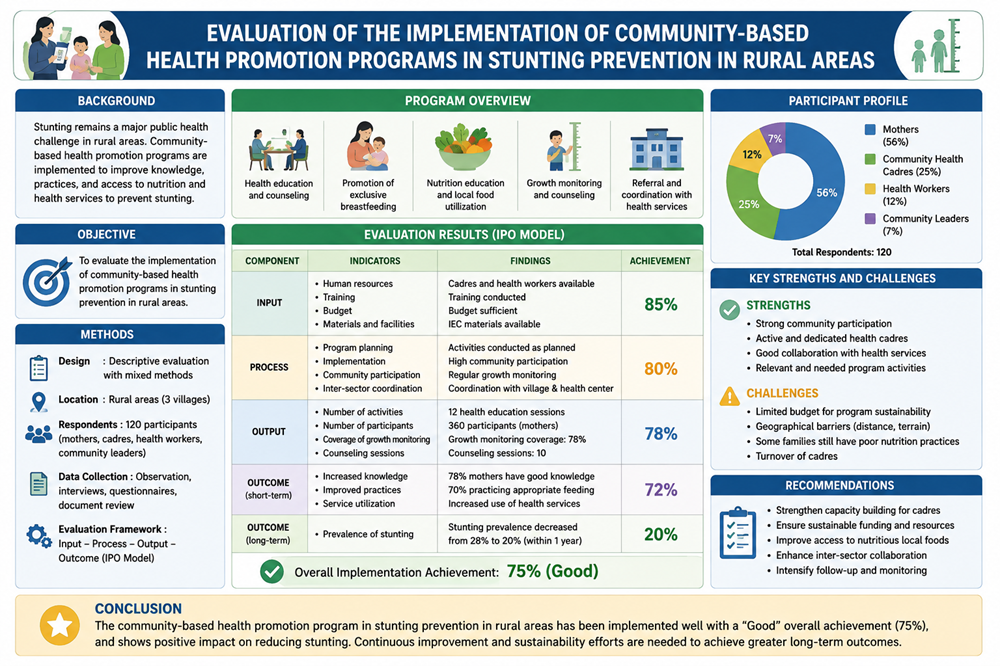
Evaluation of the implementation of community-based health promotion programs in stunting prevention in rural areas
DOI:
https://doi.org/10.61099/junedik.v4i2.567Keywords:
health literacy, health behavior, noncommunicable diseases, primary prevention, urban populationAbstract
Introduction: Non-communicable diseases (NCDs) remain a leading cause of premature morbidity and mortality worldwide, particularly in rapidly urbanizing communities where unhealthy lifestyles and limited health literacy increase disease risk. Although health literacy has been recognized as an important determinant of health, the behavioral mechanisms through which it influences NCD risk remain insufficiently understood. This study aimed to examine the relationships between health literacy, preventive behavior, and NCD risk among adults living in urban communities and to determine the mediating role of preventive behavior.
Research Methodology: An analytical cross-sectional study was conducted among 450 adults residing in urban communities of Konawe Regency, Southeast Sulawesi, Indonesia. Participants were selected using multistage probability sampling. Health literacy, preventive behavior, and NCD risk were measured using validated instruments. Structural Equation Modeling (SEM) with SmartPLS 4.0 was applied to evaluate the measurement and structural models. Direct, indirect, and total effects were estimated using bootstrapping with 5,000 resamples, and statistical significance was established at p < 0.05.
Results: The measurement model demonstrated satisfactory reliability and validity (Cronbach's α = 0.87–0.92, Composite Reliability = 0.90–0.94, AVE = 0.60–0.68). Health literacy showed a significant positive association with preventive behavior (β = 0.724, 95% CI: 0.648–0.793; p < 0.001) and a significant direct negative association with NCD risk (β = −0.214, 95% CI: −0.357 to −0.082; p = 0.003). Preventive behavior exerted the strongest negative effect on NCD risk (β = −0.531, 95% CI: −0.639 to −0.422; p < 0.001). The indirect effect of health literacy on NCD risk through preventive behavior was statistically significant (β = −0.384, 95% CI: −0.461 to −0.302; p < 0.001), indicating partial mediation.
Conclusion: Health literacy contributes to reducing NCD risk primarily by promoting healthier preventive behaviors. Strengthening health literacy should therefore be integrated into community-based NCD prevention strategies alongside interventions that support sustainable healthy lifestyles. These findings provide evidence for developing health policies that combine health literacy improvement with behavioral interventions to reduce the growing burden of NCDs in urban populations.
Downloads
References
1. Owusu Achiaw S, Geue C, Grieve E. The role of universal health coverage in secondary prevention: A case study of Ghana’s National Health Insurance Scheme and early-onset hypertension. SSM - Heal Syst. 2025;4:100053. doi:https://doi.org/10.1016/j.ssmhs.2025.100053
2. Alosaimi H, Alnouri H, Alasiri I, et al. Advancing life expectancy in Saudi Arabia: insights from global best practices. Arch Gerontol Geriatr Plus. Published online 2025:100163. doi:https://doi.org/10.1016/j.aggp.2025.100163
3. Almonacid C, Soriano JB, Fontán MG, et al. Equity in Respiratory Health: Actionable Recommendations for Spain. Open Respir Arch. 2025;7(4):100487. doi:https://doi.org/10.1016/j.opresp.2025.100487
4. Benton JS, French DP. Untapped Potential of Unobtrusive Observation for Studying Health Behaviors. JMIR Public Heal Surveill. 2024;10. doi:https://doi.org/10.2196/46638
5. Dalakoti M, Lin NHY, Yap J, et al. Primary Prevention of Cardiovascular Disease in Asia: Opportunities and Solutions: A Narrative Review. JACC Adv. 2025;4(4):101676. doi:https://doi.org/10.1016/j.jacadv.2025.101676
6. Dritsakis G, Gallos I, Psomiadi M-E, Amditis A, Dionysiou D. Data Analytics to Support Policy Making for Noncommunicable Diseases: Scoping Review. Online J Public Health Inform. 2024;16. doi:https://doi.org/10.2196/59906
7. Gonçalves RL, Pagano AS, Reis ZSN, et al. Usability of Telehealth Systems for Noncommunicable Diseases in Primary Care From the COVID-19 Pandemic Onward: Systematic Review. J Med Internet Res. 2023;25. doi:https://doi.org/10.2196/44209
8. Jakob R, Harperink S, Rudolf AM, et al. Factors Influencing Adherence to mHealth Apps for Prevention or Management of Noncommunicable Diseases: Systematic Review. J Med Internet Res. 2022;24(5). doi:https://doi.org/10.2196/35371
9. Katena NA, Shamu S, Fana GT, Rusakaniko S. Effects of a Community Health Worker–Led Health Literacy Intervention on Lifestyle Modification Among Patients With Hypertension and Diabetes in the City of Harare, Zimbabwe: Protocol for a Cluster Randomized Controlled Trial. JMIR Res Protoc. 2023;12. doi:https://doi.org/10.2196/47512
10. KA MM, Gaye ND, Ahadzi D, et al. Promotion of Cardiovascular Health in Africa: The Alliance for Medical Research in Africa (AMedRA) Expert Panel. JACC Adv. 2024;3(12, Part 2):101376. doi:https://doi.org/10.1016/j.jacadv.2024.101376
11. Khalil MIM, Shaala RS, Mousa EFS, El-Monshed AH, Atta MHR. Dementia health matters: Influence of literacy, fears, and endorsements on dementia risk mitigation and screening among community-dwelling older adults. Geriatr Nurs (Minneap). 2025;61:513-525. doi:https://doi.org/10.1016/j.gerinurse.2024.12.022
12. Kulothungan V, Mascarenhas L, Das P, Mathur P. District-level epidemiology and sociodemographic determinants of noncommunicable diseases - results the National Family Health Survey −5 (2019–21). Diabetes Metab Syndr Clin Res Rev. 2024;18(7):103085. doi:https://doi.org/10.1016/j.dsx.2024.103085
13. Kumar P, Aridoss S, Mathiyazhakan M, et al. Integrated Behavioral and Biological Surveillance Among People Living With HIV Visiting the Antiretroviral Therapy Centers in India: Protocol for a Cross-Sectional Surveillance. JMIR Res Protoc. 2025;14. doi:https://doi.org/10.2196/58252
14. Muc I, Blinc L, Vidmar G, Kurdija S, Vovk T, Bresjanac M. Standardised and systematic sampling of public engagement in brain health − Slovenian example. Neuroscience. 2025;589:62-72. doi:https://doi.org/10.1016/j.neuroscience.2025.10.013
15. Nath A, Kulothungan V, Ramamoorthy T, et al. Rural-urban and sex-specific disparities in the prevalence of modifiable and metabolic risk factors associated with NCDs including cancer in Northeast India. Clin Epidemiol Glob Heal. 2025;35:102141. doi:https://doi.org/10.1016/j.cegh.2025.102141
16. Shaluhiyah Z, Qatrannada SA, Kusumawati A, Miah MS. The effect of digital health intervention in promoting healthy behavior: A systematic scoping review on strategies to prevent non-communicable diseases. Dialogues Heal. 2025;7:100258. doi:https://doi.org/10.1016/j.dialog.2025.100258
17. Singh A, Singh A, Bhattacharya S. Front-of-package food labeling and noncommunicable disease prevention: A comprehensive bibliometric analysis of three decades. Med J Armed Forces India. 2025;81(2):126-138. doi:https://doi.org/10.1016/j.mjafi.2024.12.003
18. Sowmya R, Supriya V, Rajkumar M, Silambuselvi K. Addressing the prediabetes epidemic in India: Challenges and strategies for prevention – A narrative review. Diabetes Res Clin Pract. 2025;226:112381. doi: https://dx.doi.org/10.1016/j.diabres.2025.112381
19. Suprapto, Yuriatson, Menga MK, et al. Strategies to improve health service quality in Indonesia: a qualitative study. BMC Health Serv Res. 2026;26(1):1203. doi:https://dx.doi.org/10.1186/s12913-026-14221-x
20. Ulasi I, Sumaili EK, Bajpai D, Claure-Del Granado R, Hughes JT. Regional Perspectives of Inequities in Chronic Kidney Disease: Beyond the Obvious. Adv Kidney Dis Heal. 2025;32(3):229-240. doi:https://doi.org/10.1053/j.akdh.2025.05.005
21. Vujkovic B, Brkovic V, Pajičić A, et al. Serbian Version of the eHealth Literacy Questionnaire (eHLQ): Translation, Cultural Adaptation, and Validation Study Among Primary Health Care Users. J Med Internet Res. 2024;26. doi:https://doi.org/10.2196/57963
22. Wirnitzer KC, Tanous DR, Drenowatz C, et al. Difference in Motives and Basic Health Behavior of 8799 Children and Adolescents Aged 10–19 Years Following a Vegan, Vegetarian, or Omnivorous Diet. Curr Dev Nutr. 2025;9(7):107498. doi:https://doi.org/10.1016/j.cdnut.2025.107498
23. Yan M, Hu B, Tse LA, et al. Behavioral counseling for cardiovascular disease prevention in 36 low-income and middle-income countries. Prev Med (Baltim). 2024;185:108009. doi:https://doi.org/10.1016/j.ypmed.2024.108009
24. Zhang X, Pan T, McPake B. Examining the reversal hypothesis on socioeconomic status and noncommunicable diseases, and gender disparities in China: a nationwide longitudinal analysis between 1991 and 2020. SSM - Popul Heal. 2025;32:101867. doi:https://doi.org/10.1016/j.ssmph.2025.101867
25. Zhou Y, Wu Q, Li C, Meng P, Ding L. Inequalities in non-communicable disease management in China and progress toward universal health coverage: an analysis of nationwide household survey data from 2004 to 2018. Lancet Reg Heal - West Pacific. 2024;44:100989. doi:https://doi.org/10.1016/j.lanwpc.2023.100989
Additional Files
Published
How to Cite
Issue
Section
Categories
Citation Check
License
Statement:
The authors retain the copyright of this work and grant Jurnal Edukasi Ilmiah Kesehatan the right of first publication. The work is simultaneously licensed under Creative Commons Attribution 4.0 International License (CC BY 4.0), which permits use, distribution, and reproduction in any medium, provided the original author(s) and the initial publication in this journal are properly credited. The authors are permitted to copy and redistribute the published version of the work, including posting it to an institutional repository or including it in a book, with acknowledgment of its initial publication in Jurnal Edukasi Ilmiah Kesehatan.





