Interactive storytelling intervention to improve adolescent mental health awareness and prevent cyberbullying
DOI:
https://doi.org/10.61099/jpmei.v3i3.573Keywords:
Adolescent mental health, Cyberbullying, Health promotion, Interactive storytelling, PreventionAbstract
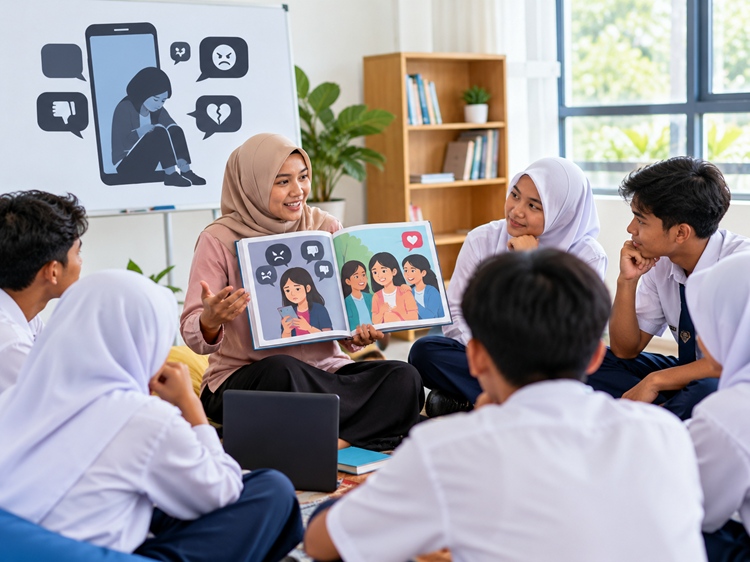
Background: Cyberbullying has emerged as an important challenge among adolescents and may negatively affect their psychological well-being. Conventional health education approaches may be less engaging for adolescents, particularly in rural settings with limited access to mental health promotion programs. Interactive storytelling offers a participatory approach that combines narratives, role-play, discussion, and reflection to strengthen adolescents’ understanding and responses to cyberbullying. This community service program aimed to improve adolescents’ knowledge, attitudes, empathy, and practical skills related to cyberbullying prevention and mental health promotion through interactive storytelling.
Methods: The program was conducted among 15 high school students in Bissolorro Village, Gowa Regency, South Sulawesi. The intervention included mental health and cyberbullying education, interactive storytelling, role-play, group discussions, simulations, and reflection. Knowledge was assessed using pre- and post-tests, while attitudes, empathy, and practical skills were evaluated through reflection sheets and facilitator observations.
Results: The mean knowledge score increased from 52.0 before the intervention to 84.1 after the intervention, representing a 32.1-point improvement. Positive attitudes were also observed: 93.3% of participants rejected cyberbullying, while 96.7% expressed willingness to support victims. All groups successfully identified cyberbullying scenarios, and 80% demonstrated appropriate response strategies and assertive communication skills.
Conclusion: Interactive storytelling was an engaging and participatory approach for improving adolescents’ knowledge, attitudes, empathy, and practical skills related to mental health promotion and cyberbullying prevention. The approach has potential for continued implementation in school-based health promotion programs.
Downloads
References
Anwar, A., Lebai Lutfi, S., Tick, A., & Janjua, L. R. (2025). Cyberbullying Victimization’s mental health toll on youth in Poland and Hungary: Role of cyber-bystanders and loneliness. Computers in Human Behavior Reports, 20, 100837. https://doi.org/10.1016/j.chbr.2025.100837
Cruickshank, L., Schaar, G. L., & Miller, P. (2026). Cyberbullying toolkit for adolescent mental health: assessment and intervention in a YMCA summer camp population. Journal of Pediatric Nursing, 91, 600–608. https://doi.org/10.1016/j.pedn.2026.08.058
Dağcı-Günal, B., & Ayaz-Alkaya, S. (2026). The effectiveness of storytelling on cyberbullying and empathy among adolescents: A randomized controlled trial. Journal of Pediatric Nursing, 91, 274–284. https://doi.org/10.1016/j.pedn.2026.08.031
Dewi, H. A., Suryani, S., & Sriati, A. (2023). relationship between cyberbullying and the risk of suicidal ideation in adolescents. Jurnal Keperawatan Padjadjaran, 11(2), 118–123. https://doi.org/10.24198/jkp.v11i2.2259
Donia, B. T., Maryam, C., Khaoula, K., Khadija, C., Hela, A., & Yousr, M. (2025). Cyberbullying and mental distress among adolescents in secondary school: Tunisian cross sectional study. Annales Médico-Psychologiques, Revue Psychiatrique, 183(4), 439–445. https://doi.org/10.1016/j.amp.2024.11.013
Eyadat, A. M., Albdour, M. M., Abusbaitan, H. A., Thongpriwan, V., Cho, Y. I., Mobarki, A., & Gwon, J. (2026). Understanding Adolescents’ Experiences of Cyberbullying in Jordan: Evidence From a Narrative Perspective. JMIR Pediatrics and Parenting, 9, e92120. https://doi.org/10.2196/92120
Henares-Montiel, J., Pastor-Moreno, G., Ramírez-Saiz, A., Rodríguez-Gómez, M., & Ruiz-Pérez, I. (2023). Characteristics and effectiveness of interventions to reduce cyberbullying: a systematic review. Frontiers in Public Health, 11, 1219727. https://doi.org/10.3389/fpubh.2023.1219727
Keles-Gordesli, B., Arabaci, L. B., & Cengisiz, C. (2025). “I was not like this before”: Exploring the lived experiences of adolescents with mental disorders on social media through interpretative phenomenological analysis. Archives of Psychiatric Nursing, 57, 151933. https://doi.org/10.1016/j.apnu.2025.151933
Khan, N. (2026). Social media use and mental health: core risks and clinical implications. Clinics in Integrated Care, 36, 100317. https://doi.org/10.1016/j.intcar.2026.100317
Kim, Y., & Oh, H. (2026). Smartphone use, sleep, and mental health in Korean adolescents. Journal of Affective Disorders, 400, 121153. https://doi.org/10.1016/j.jad.2026.121153
Lan, M., Law, N., & Pan, Q. (2022). Effectiveness of anti-cyberbullying educational programs: A socio-ecologically grounded systematic review and meta-analysis. Computers in Human Behavior, 130, 107200. https://doi.org/10.1016/j.chb.2022.107200
Lee, J., Choo, H., Zhang, Y., Cheung, H. S., Zhang, Q., & Ang, R. P. (2026). Cyberbullying Victimization and Mental Health Symptoms Among Children and Adolescents: A Meta-Analysis of Longitudinal Studies. Trauma, Violence, & Abuse, 27(2), 391–406. https://doi.org/10.1177/15248380241313051
Leegstra, L. M., Damian, D., & Maxwell, L. (2024). What effects do mental health policies have on adolescent suicidal ideation or behavior, suicide, and bullying? A systematic review. Social Sciences & Humanities Open, 10, 101057. https://doi.org/10.1016/j.ssaho.2024.101057
Li, C., Wang, P., Martin-Moratinos, M., Bella-Fernández, M., & Blasco-Fontecilla, H. (2024). Traditional bullying and cyberbullying in the digital age and its associated mental health problems in children and adolescents: a meta-analysis. European Child & Adolescent Psychiatry, 33(9), 2895–2909. https://doi.org/10.1007/s00787-022-02128-x
Li, Y., Knoll, M., & Obsuth, I. (2026). Cyberbullying victimization and adolescent emotional and conduct problems: Roles of loneliness, emotion dysregulation, and self-esteem. Journal of Affective Disorders, 412, 122151. https://doi.org/10.1016/j.jad.2026.122151
Lokittithonkul, T., Suwanwong, C., & Prasittichok, P. (2026). Beyond mental health awareness: Evaluating a blended mental health literacy program to improve adolescents’ coping with school bullying. Social Sciences & Humanities Open, 14, 103240. https://doi.org/10.1016/j.ssaho.2026.103240
Luis, S. E., Veremu, G., Namacala, E. L., & Gama-Krummel, A. (2026). A narrative theoretical review of research on factors associated with media use and mental health among adolescents and emerging adults. Mental Health and Digital Technologies, 3(2), 228–250. https://doi.org/10.1108/MHDT-03-2025-0020
Maji, S., & Abhiram, A. H. (2023). ``Mental health cost of internet’’: A mixed-method study of cyberbullying among Indian sexual minorities. Telematics and Informatics Reports, 10, 100064. https://doi.org/10.1016/j.teler.2023.100064
Nagata, J. M., Shim, J., Balasubramanian, P., Leong, A. W., Smith-Russack, Z., Shao, I. Y., Al-Shoaibi, A. A. A., Helmer, C. K., Ganson, K. T., Testa, A., Kiss, O., He, J., Groves, A. K., Baird, S., & Baker, F. C. (2025). Cyberbullying, mental health, and substance use experimentation among early adolescents: a prospective cohort study. The Lancet Regional Health - Americas, 46, 101002. https://doi.org/10.1016/j.lana.2025.101002
Prabadewi, D. A., & Surjaningrum, E. (2022). A systematic literature review to identify psychological impact of cyberbullying. Jurnal Riset Psikologi, 5(4), 144–156. https://doi.org/10.24036/jrp.v5i4.13777
Roberts, C. E., Lorenz, A., & Battle, C. (2026). Will the House Settlement Affect College Athlete Mental Health? You Can Bet on It. Advances in Psychiatry and Behavioral Health, 6(1), 19–31. https://doi.org/10.1016/j.ypsc.2026.04.002
Roggendorf, P., & Volkov, A. (2025). Cyberbullying as a mental health problem in a dynamic socio-informational environment: a conceptual paper. International Journal of Health Governance, 30(3), 293–307. https://doi.org/10.1108/IJHG-12-2024-0157
Santre, S. (2023). Cyberbullying in adolescents: a literature review. International Journal of Adolescent Medicine and Health, 35(1), 1–7. https://doi.org/10.1515/ijamh-2021-0133
Shi, Y., Lau, Y., Chan, H. H. H., Choi, J. K. K., Calvo-Morata, A., & Wong, S. H. (2025). School-Based Intervention on Cyberbullying-Related Outcomes and Psycho-Social Well-Being in Children and Adolescents: A Systematic Review and Meta-Analysis. Trauma, Violence, & Abuse. https://doi.org/10.1177/15248380251375480
Suprapto, S., Darmi Arda, & Andi Latif, S. (2026). MENTALCARE: Community-based adolescent empowerment through mental health education, early screening, and support in makassar city. Abdimas Polsaka, 73–80. https://doi.org/10.35816/abdimaspolsaka.v5i2.540
Zhu, C., Huang, S., Evans, R., & Zhang, W. (2021). Cyberbullying Among Adolescents and Children: A Comprehensive Review of the Global Situation, Risk Factors, and Preventive Measures. Frontiers in Public Health, 9, 634909. https://doi.org/10.3389/fpubh.2021.634909
Downloads
Published
How to Cite
Issue
Section
Citation Check
License
Copyright (c) 2026 Dian Meiliani Yulis, Dewi Nurliasari Yulis, Rusli Rusli

This work is licensed under a Creative Commons Attribution 4.0 International License.