Empowering families and health cadres in stunting prevention through nutrition education and assistance for toddler growth and development
DOI:
https://doi.org/10.61099/jpmei.v3i3.572Keywords:
community empowerment, growth and development, health cadres, nutrition education, stunting preventionAbstract
Background: Stunting remains an important public health concern because it can adversely affect children's physical growth, cognitive development, and future quality of life. Family involvement and the active participation of community health cadres are essential for improving nutritional practices and ensuring regular monitoring of toddler growth and development.
Objective: This community empowerment program aimed to improve the knowledge and practical capacity of families and health cadres in preventing stunting through nutrition education and assistance in monitoring toddler growth and development.
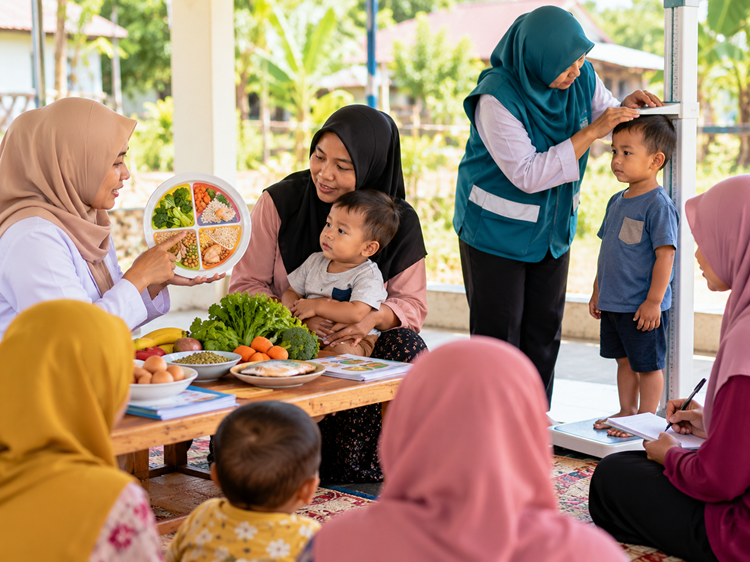
Methods: The program was implemented using a participatory approach involving families with toddlers and community health cadres. Activities included nutrition education, counseling on balanced diets and appropriate complementary feeding, demonstrations of child growth measurement, developmental monitoring, and individualized assistance. Participants' knowledge was assessed before and after the educational sessions using structured questionnaires. Growth monitoring included measurements of body weight and height/length, while developmental assistance emphasized age-appropriate stimulation and early identification of developmental concerns.
Results: The program showed an improvement in participants' knowledge regarding stunting prevention, balanced nutrition, appropriate feeding practices, and growth monitoring. Families demonstrated greater awareness of the importance of regular growth and development monitoring and appropriate nutritional practices. Health cadres also showed improved capacity to provide nutrition education, conduct basic anthropometric monitoring, identify children at risk of growth problems, and encourage families to utilize community-based health services regularly.
Conclusion: Nutrition education combined with family assistance and strengthened health cadre capacity is a practical community-based strategy for supporting stunting prevention. Continuous mentoring and regular growth and development monitoring are recommended to sustain behavioral improvements and facilitate early detection of nutritional and developmental problems.
Downloads
References
Ajeng Wijayanti, L., Hijrah, H., Millati, R., Fredy Saputra, M. K., Suprapto, S., & Tri Wijayanti, Y. (2025). Improving nurse competence in health centers through practice-based training. Jurnal Pengabdian Masyarakat Edukasi Indonesia, 2(1), 9–16. https://doi.org/10.61099/jpmei.v2i1.64
Anastasia, H., Hadju, V., Hartono, R., Samarang, Manjilala, Sirajuddin, Salam, A., & Atmarita. (2023). Determinants of stunting in children under five years old in South Sulawesi and West Sulawesi Province: 2013 and 2018 Indonesian Basic Health Survey. PLOS ONE, 18(5), e0281962. https://doi.org/10.1371/journal.pone.0281962
Arqam, M. L., Firdaus, A. A., Atmojo, A. M., Saputri, G. Z., Furizal, Palahuddin, & Sirnopati, R. (2026). Integrating education-based interventions and machine learning for stunting prevention: A case study in East Lombok, Indonesia. Dialogues in Health, 8, 100264. https://doi.org/10.1016/j.dialog.2025.100264
Beatty, A., Borkum, E., Leith, W., Null, C., & Suriastini, W. (2024). A cluster randomized controlled trial of a community‐based initiative to reduce stunting in rural Indonesia. Maternal & Child Nutrition, 20(1), e13593. https://doi.org/10.1111/mcn.13593
Garina, L. A., Dewi, M. K., Trusda, S. A. D., Purbaningsih, W., Muflihah, H., Tursina, A., Respati, T., & Rahimah, S. B. (2024). Maternal, Child, and Household Risk Factors for Children with Stunting. The Open Public Health Journal, 17(1). https://doi.org/10.2174/0118749445321448240823112908
Gusnedi, G., Nindrea, R. D., Purnakarya, I., Umar, H. B., Andrafikar, Syafrawati, Asrawati, Susilowati, A., Novianti, Masrul, & Lipoeto, N. I. (2023). Risk factors associated with childhood stunting in Indonesia: A systematic review and meta-analysis. Asia Pacific Journal of Clinical Nutrition, 32(2), 184–195. https://doi.org/https://dx.doi.org/10.6133/apjcn.202306_32(2).0001
Indonesia, K. K. R. (2023). Survei Kesehatan Indonesia (SKI) 2023. Kementerian Kesehatan Republik Indonesia. https://www.kemkes.go.id/id/survei-kesehatan-indonesia-ski-2023
Ipa, M., Astuti, E. P., Yuliasih, Y., Kusrini, I., Setyaningtyas, D. E., Anggraeni, Y. M., Mujiyanto, Paramashanti, B. A., & Tjandrarini, D. H. (2026). Caregiver-based nutrition interventions: A strategy optimizing linear growth in children under two years in Garut Regency, Indonesia. Clinical Epidemiology and Global Health, 39, 102330. https://doi.org/10.1016/j.cegh.2026.102330
Klemm, G. C., Kayanda, R., Kazoba, A., McCann, J., Nnally, L. P., & Dickin, K. L. (2022). Translating Multisectoral Nutrition Policy into Community Practice: Participation of Nutrition Officers in Tanzania Fosters Effective Collaborative Strategies to Improve Child Nutrition. Current Developments in Nutrition, 6(4), nzac030. https://doi.org/10.1093/cdn/nzac030
Laksono, A. D., Wulandari, R. D., Amaliah, N., & Wisnuwardani, R. W. (2022). Stunting among children under two years in Indonesia: Does maternal education matter? PLOS ONE, 17(7), e0271509. https://doi.org/10.1371/journal.pone.0271509
Lum, H., Soe, K. M., Thi, W. M., Htike, K. M., & Mahato, R. K. (2026). Childhood Malnutrition and its Predictors: A Comparative Cross-Sectional Study on Stunting and Wasting in Under-Five Children Along the Myanmar–China Border. Journal of Pediatric Health Care, 40(5), 678–689. https://doi.org/10.1016/j.pedhc.2026.03.005
Mardani, R. A. D., Wu, W.-R., Hajri, Z., Thoyibah, Z., Yolanda, H., & Huang, H.-C. (2024). Effect of a Nutritional Education Program on Children’s Undernutrition in Indonesia: A Randomized Controlled Trial. Journal of Pediatric Health Care, 38(4), 552–563. https://doi.org/10.1016/j.pedhc.2024.02.006
Mulyani, A. T., Khairinisa, M. A., Khatib, A., & Chaerunisaa, A. Y. (2025). Understanding Stunting: Impact, Causes, and Strategy to Accelerate Stunting Reduction—A Narrative Review. Nutrients, 17(9), 1493. https://doi.org/10.3390/nu17091493
Organization, W. H., Fund, U. N. C., & Group, W. B. (2025). Levels and trends in child malnutrition: UNICEF/WHO/World Bank Group joint child malnutrition estimates: Key findings of the 2025 edition. World Health Organization. https://www.who.int/publications/i/item/9789240112308
Patange, A., Nemane, V., Gupta, K., Mishra, A. K., Mamadieva, Z., Djumaniyazova, M., & Matniyazov, X. (2026). Informed consent and confidentiality in community-level tuberculosis interventions. Indian Journal of Tuberculosis, 73, S52–S57. https://doi.org/10.1016/j.ijtb.2026.02.015
Prayitno, G., Zuhriyah, L., Efendi, A., Arifin, S., Rahmawati, Auliah, A., & Subagiyo, A. (2025). Community-powered environmental pathways to reduce stunting: Food security, social capital, and open innovation in semi-urban Indonesia. Environmental Challenges, 21, 101350. https://doi.org/10.1016/j.envc.2025.101350
Setiawan, A., Syamsir, S. B., Rahmadiyah, D. C., Astuti, Atamou, L., Talilah, R., & Shorey, S. (2026). Effects of family-based nursing interventions on mothers’ knowledge, attitudes, and self-efficacy related to stunting prevention in Indonesia: A quasi-experimental study. International Journal of Nursing Sciences, 13(2), 113–121. https://doi.org/10.1016/j.ijnss.2026.02.008
Siramaneerat, I., Astutik, E., Agushybana, F., Bhumkittipich, P., & Lamprom, W. (2024). Examining determinants of stunting in Urban and Rural Indonesian: a multilevel analysis using the population-based Indonesian family life survey (IFLS). BMC Public Health, 24(1), 1371. https://doi.org/10.1186/s12889-024-18824-z
Suprapto. (2026). Stunting Policy Implementation in Indonesia: A Primary Health Care Perspective. Jurnal Ilmiah Kesehatan Sandi Husada, 15(1), 347–361. https://doi.org/10.35816/jiksh.v15i1.302
Suprapto, S., Arda, D., Kurni Menga, M., Adji Saktiawan, B., & Nggaá Woge, S. (2025). OPTIMALCARE: Community-based homecare policy innovation in accelerating stunting reduction in Makassar City. Abdimas Polsaka, 4(2), 148–156. https://doi.org/10.35816/abdimaspolsaka.v4i2.107
Susanto, T., Rasni, H., & Wuryaningsih, E. W. (2026). “It’s Hard to Feed Them Right”: A Phenomenological Analysis of Dietary Diversity, Family Sanitation, and Food Access in Rural Indonesian Stunting Cases. Journal of Pediatric Health Care. https://doi.org/10.1016/j.pedhc.2026.07.010
Taofik, M. J., Satispi, E., & Hadi, M. (2026). Cultural governance and policy implementation in public health: Accelerating stunting reduction in East Lombok through social integration and institutional capacity. Social Sciences & Humanities Open, 13, 102360. https://doi.org/10.1016/j.ssaho.2025.102360
Downloads
Published
How to Cite
Issue
Section
Citation Check
License
Copyright (c) 2026 Syaharuddin Syaharuddin, Dewi Nurhanifah, Ari Setiawati, Indrawati Aris, Sylvia Bawiling, Suprapto Suprapto

This work is licensed under a Creative Commons Attribution 4.0 International License.