
Community-based mental health education and early screening for adolescents

DOI:
https://doi.org/10.35816/abdimaspolsaka.v5i2.546Keywords:
adolescent mental health, community-based intervention, early screening, health education, mental health literacyAbstract
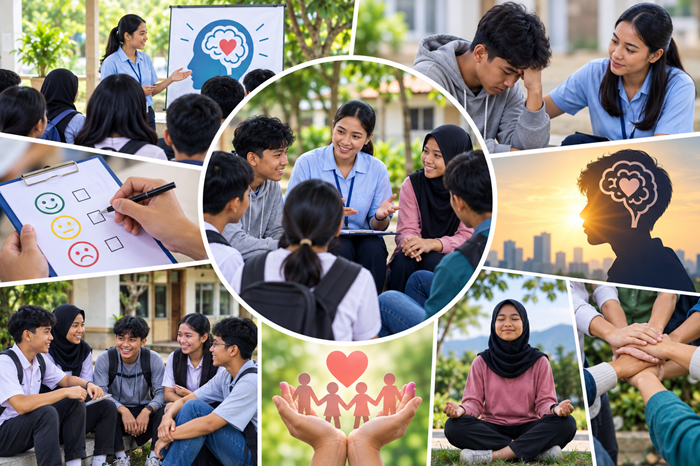
Adolescent mental health problems remain an important public health concern, particularly because limited mental health literacy, stigma, and inadequate help-seeking behavior can delay early identification and appropriate support. This community engagement program aimed to improve adolescent mental health literacy, strengthen early recognition of psychological problems, promote peer support, and facilitate appropriate referral pathways through community-based education and early screening. The program employed a participatory community-based approach with a one-group pretest–posttest evaluation design involving 30 adolescents. Activities included interactive mental health education, guided discussion, early screening, peer-support strengthening, brief counseling, mentoring, and referral when further professional assessment was indicated. Educational media consisted of presentations, modules, infographics, videos, and digital resources. Program effectiveness was evaluated by comparing pretest and posttest mental health literacy scores and assessing participant engagement and understanding of help-seeking pathways. The mean mental health literacy score increased from 55.5 at pretest to 83.4 at posttest, representing an average improvement of 27.9 points. Participants also demonstrated better understanding of anxiety and depression symptoms, adaptive coping strategies, stigma reduction, peer communication, and available referral services. The program additionally strengthened community capacity to identify adolescents requiring further support. In conclusion, community-based mental health education combined with early screening is a feasible promotive and preventive strategy for improving adolescent mental health literacy and facilitating timely referral. Continued implementation and longer-term follow-up are recommended to strengthen sustainability and assess behavioral outcomes.
References
1. Akbar K F, Syamsidar S, Hermawan A. Impact of a caregiver empowerment intervention within an age friendly village model on depression and loneliness in older adults: A Quasi Experimental Study. J Ilm Kesehat Sandi Husada. 2026;15(1 SE-Articles):200-210. doi:10.35816/jiksh.v15i1.236
2. Andi Mukarramah, Lestari Lorna Lolo, Nancy Sylvia Bawiling, Suprapto. Community-Based Family Education and Assistance for Improved Nutrition. Abdimas Polsaka. 2026;5(1 SE-Articles):33-39. doi:10.35816/abdimaspolsaka.v5i1.199
3. Chen Q, Zhao Z, Bao J, Lin J, Li W, Zang Y. Digital empowerment in mental health: A meta-analysis of internet-based interventions for enhancing mental health literacy. Int J Clin Heal Psychol. 2024;24(3):100489. doi:https://doi.org/10.1016/j.ijchp.2024.100489
4. Fine SL, Lai J, Baack MRM, De Oliveira JD, Blum RW. Adolescents’ Reflections on Mental Health: Key Findings From a 13-Country Qualitative Study. J Adolesc Heal. 2025;77(3):436-443. doi:https://doi.org/10.1016/j.jadohealth.2024.09.005
5. Gunlicks-Stoessel M, Rydberg K, Parikh RR, et al. Scoping Review: Perceived Needs, Barriers, Facilitators, and Satisfaction With Access and Utilization of Mental Health Services Among Rural Adolescents and Parents in the United States. JAACAP Open. 2025;3(4):825-838. doi:10.1016/j.jaacop.2025.06.008
6. Harerimana A, Pillay JD, Mchunu G. Mindfulness-based interventions for mental health in refugee and migrant populations: A scoping review. SSM - Ment Heal. 2025;8:100540. doi:https://doi.org/10.1016/j.ssmmh.2025.100540
7. Kornfield R, Popowski SA, Tack E, et al. Designing Digital Mental Health Interventions to Meet the Needs of Older Adolescents: Qualitative Interview and Group Discussion Study. JMIR Form Res. 2025;9. doi:https://doi.org/10.2196/68950
8. Ladegard K, Alleyne S, Close J, Hwang MD. The Role of School-based Interventions and Communities for Mental Health Prevention, Tiered Levels of Care, and Access to Care. Child Adolesc Psychiatr Clin N Am. 2024;33(3):381-395. doi:https://doi.org/10.1016/j.chc.2024.03.004
9. Long J, Zhang S, Chu L, et al. Policies, resource allocation, and interventions for child and adolescent mental health in low- and middle-income countries in the Western Pacific Region: a scoping review. Lancet Reg Heal - West Pacific. 2025;62:101674. doi:10.1016/j.lanwpc.2025.101674
10. Luis SE, Veremu G, Namacala EL, Gama-Krummel A. A narrative theoretical review of research on factors associated with media use and mental health among adolescents and emerging adults. Ment Heal Digit Technol. 2025;3(2):228-250. doi:https://doi.org/10.1108/MHDT-03-2025-0020
11. Mendelson T, Clary LK, Musci RJ, et al. Positive impacts of a universal trauma-informed intervention on student mental health: The Project POWER trial. J Sch Psychol. 2025;112:101469. doi:https://doi.org/10.1016/j.jsp.2025.101469
12. Murphy J, Craft K, Kim Y. Challenges in school-based mental health service utilization: a qualitative study with school social workers. Child Youth Serv Rev. 2025;178:108537. doi:https://doi.org/10.1016/j.childyouth.2025.108537
13. Nagata JM, Shim J, Balasubramanian P, et al. Cyberbullying, mental health, and substance use experimentation among early adolescents: a prospective cohort study. Lancet Reg Heal - Am. 2025;46:101002. doi:https://doi.org/10.1016/j.lana.2025.101002
14. Ng DTK, Du C, Cheung KKC, McIntyre N. The use and impact of digital interventions on mental health and wellbeing of forced migrants: A systematic review of empirical studies. Comput Human Behav. 2025;172:108755. doi:https://doi.org/10.1016/j.chb.2025.108755
15. Okumu M, Logie CH, Byansi W, et al. eHealth literacy and digital health interventions: Key ingredients for supporting the mental health of displaced youth living in the urban slums of kampala, Uganda. Comput Human Behav. 2025;162:108434. doi:https://doi.org/10.1016/j.chb.2024.108434
16. Rapee RM, Kuhnert R-L, Bowsher I, et al. A Cluster Randomized Trial of the Impact of School-Based, Universal, Mental Health Screening and Feedback on Students’ Mental Health and Help-Seeking. J Am Acad Child Adolesc Psychiatry. 2025;64(11):1295-1304. doi:https://doi.org/10.1016/j.jaac.2025.01.032
17. Ray S, Pal AK, Kundu PS, Santosh S. School mental health in India: The present scenario and future directions’. Ment Heal Prev. 2025;40:200444. doi:10.1016/j.mhp.2025.200444
18. Sim A, Puffer E, Eagling-Peche S, et al. Parenting on the border: Study protocol for a randomized controlled trial of a trauma-informed, edutainment-enhanced intervention to improve parenting and mental health among migrant and displaced caregivers in Thailand. SSM - Ment Heal. 2025;8:100516. doi:https://doi.org/10.1016/j.ssmmh.2025.100516
19. Sluis RA, Ryan KM, Waters AM. Mental Health Screening and Early Intervention Within Youth Sports Development Programs: A Review of the Literature. Psychiatr Clin North Am. 2025;48(4):699-707. doi:https://doi.org/10.1016/j.psc.2025.06.004
20. Yılmaz İS, Yılmaz-Özdemir İ, Woodhead C. Examining factors influencing forcibly displaced children and youth’s access to mental health support: An overview of reviews. Child Youth Serv Rev. 2025;176:108431. doi:https://doi.org/10.1016/j.childyouth.2025.108431
21. Zeiler M, Vögl S, Prinz U, et al. Game Design, Effectiveness, and Implementation of Serious Games Promoting Aspects of Mental Health Literacy Among Children and Adolescents: Systematic Review. JMIR Ment Heal. 2025;12. doi:https://doi.org/10.2196/67418
22. Suprapto S, Arda D. Pemberdayaan Masyarakat Melalui Penyuluhan Perilaku Hidup Bersih dan Sehat Meningkatkan Derajat Kesehatan Masyarakat. J Pengabdi Kesehat Komunitas. 2021;1(2):77-87. doi:https://doi.org/10.25311/jpkk.Vol1.Iss2.957
23. Toledo E, Skues J, Blasche R, Sharp J. A scoping review of mental health literacy research in young people beyond the school context. Ment Heal Prev. 2025;40:200466. doi:https://doi.org/10.1016/j.mhp.2025.200466
24. Yeo G, Reich SM, Liaw NA, Chia EYM. The Effect of Digital Mental Health Literacy Interventions on Mental Health: Systematic Review and Meta-Analysis. J Med Internet Res. 2024;26. doi:https://doi.org/10.2196/51268
25. Wanniarachchi VU, Greenhalgh C, Warren J. Adolescents’ and youths’ perceived barriers and facilitators to engaging with digital mental health interventions for depression and anxiety: A scoping review. Internet Interv. 2025;42:100884. doi:https://doi.org/10.1016/j.invent.2025.100884
26. Wecht S, Hendrixson M, Radović A. A Mixed Method Investigation of Parent-Adolescent Communication About Mental Health. J Adolesc Heal. 2024;75(6):904-911. doi:https://doi.org/10.1016/j.jadohealth.2024.07.012
27. Woollett N, van Eck L, Mazibuko L, et al. Sisonke Ntwana: Describing the mechanisms of change of an arts-based intervention for pregnant and parenting adolescents experiencing violence and poor mental health in South Africa. Child Abuse Negl. 2025;161:107248. doi:https://doi.org/10.1016/j.chiabu.2025.107248
28. Xu Y, Chen Z. The Interactive Effects of eHealth Literacy and Mental Health Literacy on Social Media Addiction and Depression-Anxiety-Stress in Adolescents: Cross-Sectional Study. J Med Internet Res. 2025;27:e81741. doi:10.2196/81741
Downloads
Published
How to Cite
Issue
Section
License
Copyright (c) 2026 Nofita Tudang Rombeallo, Rasi Rahagia, Ari Setiawati, Yoga Tri Wijayanti

This work is licensed under a Creative Commons Attribution 4.0 International License.


Most read articles by the same author(s)
- Yoga Tri Wijayanti, Warlinda, Hartaty, Ririn Indriani, Fatimah, Assistance for pregnant women at risk in efforts to prevent pregnancy complications , Abdimas Polsaka: Vol. 4 No. 2 (2025): Volume 4 Number 2 September 2025
- Risna Ayu Rahmadani, Prasetyowati, Indrawati Aris Tyarini, Rasi Rahagia, Matilda Martha Paseno, Nutritious food education and the practice of providing complementary foods are appropriate in efforts to prevent stunting , Abdimas Polsaka: Vol. 4 No. 2 (2025): Volume 4 Number 2 September 2025
Similar Articles
- Suharni. A.Fachrin, Alfina Baharuddin, Fatma Jama, Hukma Ratu Purnama, Personal protective equipment as a measure to limit disability among ironworkers in maros regency , Abdimas Polsaka: Vol. 4 No. 2 (2025): Volume 4 Number 2 September 2025
- Yoga Tri Wijayanti, Warlinda, Hartaty, Ririn Indriani, Fatimah, Assistance for pregnant women at risk in efforts to prevent pregnancy complications , Abdimas Polsaka: Vol. 4 No. 2 (2025): Volume 4 Number 2 September 2025
- Rahmansah, Bakhrani A. Rauf, Syafiuddin Parenrengi, Herman, Dissemination of environmentally friendly appropriate technology to increase corn added value in South Bontolangkasa Village, Gowa Regency , Abdimas Polsaka: Vol. 5 No. 1 (2026): Volume 5 Number 1 March 2026
- Alimuddin Sa’ban Miru, Faizal Amir, Darmawang, Siti Hadijah, Bakhrani A. Rauf, Empowerment of PKK mothers through seaweed-based culinary diversification training in the Coastal Area of Salemo Island , Abdimas Polsaka: Vol. 5 No. 1 (2026): Volume 5 Number 1 March 2026
- Yuliati, Alfina Baharuddin, Hardi, Siti Astachya Ananda Sofyan, Suharni A. Fachrin, Ella Andayanie, Optimizing clean water filtration through the application of science and technology: Reverse osmosis method , Abdimas Polsaka: Vol. 4 No. 2 (2025): Volume 4 Number 2 September 2025
- Uliarta Marbun, Irnawati, Hasnita, Empowering couples of childbearing age to become active family planning acceptors to create quality families , Abdimas Polsaka: Vol. 4 No. 2 (2025): Volume 4 Number 2 September 2025
- Yuriatson, Rosmiaty, Anwar Taufiq, Luana Sasabone, Nurliah, Kaharto, Role-play as a community service strategy to improve english communication for nursing students , Abdimas Polsaka: Vol. 4 No. 2 (2025): Volume 4 Number 2 September 2025
You may also start an advanced similarity search for this article.


