
MENTALCARE: Community-based adolescent empowerment through mental health education, early screening, and support in makassar city

DOI:
https://doi.org/10.35816/abdimaspolsaka.v5i2.540Keywords:
adolescent mental health, community-based intervention, early screening, health education, mental health literacyAbstract
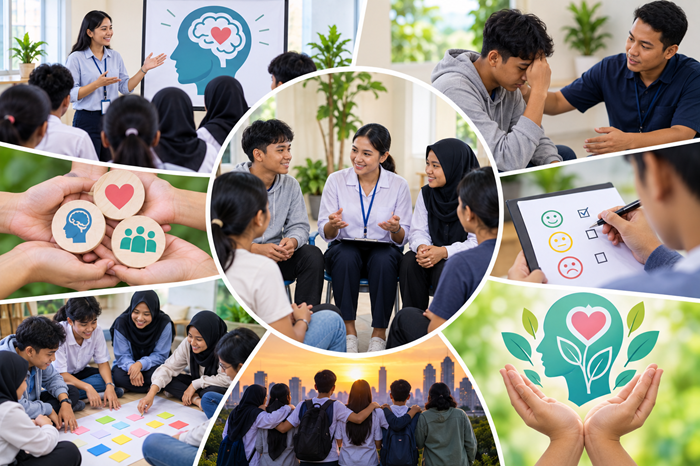
Adolescent mental health problems are increasingly recognized as a major public health concern, particularly because limited mental health literacy, stigma, and inadequate help-seeking behavior may delay early identification and appropriate care. The MENTALCARE program aimed to improve adolescent mental health literacy, strengthen early recognition of psychological problems, promote peer support, and facilitate appropriate referral pathways in Makassar City, Indonesia. The program used a community-based participatory approach with a one-group pretest–posttest evaluation design involving 30 adolescents. Activities included interactive mental health education, discussion, early screening, peer-support strengthening, initial counseling, and referral when further professional assessment was indicated. Educational materials included presentations, modules, infographics, videos, and digital resources, while evaluation focused on changes in mental health literacy and help-seeking knowledge. The mean mental health literacy score increased from 55.5 at pretest to 83.4 at posttest, representing an average improvement of 27.9 points. Participants also gained greater understanding of anxiety and depression symptoms, healthy coping strategies, stigma reduction, peer communication, and available referral pathways. The program benefited community partners by strengthening their capacity to identify adolescents requiring additional support and connect them with appropriate health services. In conclusion, MENTALCARE demonstrates the feasibility of integrating education, early screening, peer support, and referral within a community-based adolescent mental health program. Continued implementation, standardized evaluation, and longer-term follow-up are recommended to strengthen sustainability and assess lasting behavioral and psychological outcomes
References
1. Akbar F, Ahmad A, Mando S. The Effect Of Mental Health Literacy Education On Improving Adolescents’ Knowledge And Attitudes Toward Mental Health. J Kesehat Manarang. 2026;12(1):30-37. doi:10.33490/jkm.v12i1.2046
2. Chen Q, Zhao Z, Bao J, Lin J, Li W, Zang Y. Digital empowerment in mental health: A meta-analysis of internet-based interventions for enhancing mental health literacy. Int J Clin Heal Psychol. 2024;24(3):100489. doi:https://doi.org/10.1016/j.ijchp.2024.100489
3. Pham MD, Wulan NR, Sawyer SM, al. et. Mental health problems among Indonesian adolescents: Findings of a cross-sectional study utilising validated scales and innovative sampling methods. J Adolesc Heal. 2024;75(6):929-938. doi:10.1016/j.jadohealth.2024.07.016
4. Erskine HE, Maravilla JC, Wado YD, et al. Prevalence of adolescent mental disorders in Kenya, Indonesia, and Viet Nam measured by the National Adolescent Mental Health Surveys (NAMHS): a multi-national cross-sectional study. Lancet. 2024;403(10437):1671-1680. doi:10.1016/S0140-6736(23)02641-7
5. Government MC. Makassar City Medium-Term Development Plan 2025–2029. Makassar City Government; 2025.
6. Luis SE, Veremu G, Namacala EL, Gama-Krummel A. A narrative theoretical review of research on factors associated with media use and mental health among adolescents and emerging adults. Ment Heal Digit Technol. 2025;3(2):228-250. doi:https://doi.org/10.1108/MHDT-03-2025-0020
7. Mendelson T, Clary LK, Musci RJ, et al. Positive impacts of a universal trauma-informed intervention on student mental health: The Project POWER trial. J Sch Psychol. 2025;112:101469. doi:https://doi.org/10.1016/j.jsp.2025.101469
8. Irmawati S, Masdar FFM, Rosdianah, Yunus M. Digital mental health education: The impact of e-book intervention on anxiety knowledge among adolescent girls. J Ilm Kesehat Sandi Husada. 2025;14(2):323-330. doi:10.35816/jiksh.v14i2.278
9. Ibnu IF, Sandy G. Enhancing adolescent mental health through independence and social support: A cross-sectional study in Makassar, Indonesia. Al-Sihah Public Heal Sci J. 2025;17(1):67-77. doi:10.24252/al-sihah.v17i1.55439
10. Grant M, Petersen I, Mthethwa L, Luvuno Z, Bhana A. Accuracy of a community mental health education and detection (CMED) tool for common mental disorders in KwaZulu-Natal, South Africa. Int J Ment Health Syst. 2022;16(1):44. doi:10.1186/s13033-022-00554-7
11. Kaligis F, Ismail RI, Wiguna T, al. et. Translation, validity, and reliability of mental health literacy and help-seeking behavior questionnaires in Indonesia. Front Psychiatry. 2022;12:764666. doi:10.3389/fpsyt.2021.764666
12. Mustaking Mustaking Suprapto Suprapto TS. Developing an Integrated Bureaucratic Reform Model to Improve Public Healthcare Service Quality in Indonesia: A Sequential Explanatory Mixed-Methods Study. Soc Sci Humanit Open. Published online 2026:21.
13. Lesmana MHS, Chung MH. Mediating roles of perceived stigma and mental health literacy in the relationship between school climate and help-seeking behavior in Indonesian adolescents. PLoS One. 2024;19(5):e0298017. doi:10.1371/journal.pone.0298017
14. Ladegard K, Alleyne S, Close J, Hwang MD. The Role of School-based Interventions and Communities for Mental Health Prevention, Tiered Levels of Care, and Access to Care. Child Adolesc Psychiatr Clin N Am. 2024;33(3):381-395. doi:https://doi.org/10.1016/j.chc.2024.03.004
15. Long J, Zhang S, Chu L, et al. Policies, resource allocation, and interventions for child and adolescent mental health in low- and middle-income countries in the Western Pacific Region: a scoping review. Lancet Reg Heal - West Pacific. 2025;62:101674. doi:10.1016/j.lanwpc.2025.101674
16. Suprapto Maria Kurni Menga, Darmi Arda, N. L. Nur Syamsi, Trimaya Cahya Mulat, Yohan Trayanus Djaha & Tirta Asprimi Angreani Y. Strategies to improve health service quality in Indonesia: a qualitative study. BMC Health Serv Res. Published online 2026.
17. Vicary E, al. et. Bridging the gap in mental health literacy: Co-adapting and feasibility testing a digital intervention to improve mental health literacy amongst young people aged 12–14 in the UK. Front Psychiatry. 2025;16:1546109. doi:10.3389/fpsyt.2025.1546109
18. Gunlicks-Stoessel M, Rydberg K, Parikh RR, et al. Scoping Review: Perceived Needs, Barriers, Facilitators, and Satisfaction With Access and Utilization of Mental Health Services Among Rural Adolescents and Parents in the United States. JAACAP Open. 2025;3(4):825-838. doi:10.1016/j.jaacop.2025.06.008
19. Harerimana A, Pillay JD, Mchunu G. Mindfulness-based interventions for mental health in refugee and migrant populations: A scoping review. SSM - Ment Heal. 2025;8:100540. doi:https://doi.org/10.1016/j.ssmmh.2025.100540
20. Hargraves JL, Cosenza C, Cleary PD. Measuring Access to Mental Health Services Among Primary Care Patients. Med Care. 2024;62(8):559-566. doi:10.1097/MLR.0000000000002029
21. Kornfield R, Popowski SA, Tack E, et al. Designing Digital Mental Health Interventions to Meet the Needs of Older Adolescents: Qualitative Interview and Group Discussion Study. JMIR Form Res. 2025;9. doi:https://doi.org/10.2196/68950
22. Murphy J, Craft K, Kim Y. Challenges in school-based mental health service utilization: a qualitative study with school social workers. Child Youth Serv Rev. 2025;178:108537. doi:https://doi.org/10.1016/j.childyouth.2025.108537
Downloads
Published
How to Cite
Issue
Section
License
Copyright (c) 2026 Suprapto Suprapto, Darmi Arda, Sarifudin Andi Latif

This work is licensed under a Creative Commons Attribution 4.0 International License.


Most read articles by the same author(s)
- Suprapto Suprapto, Darmi Arda, Maria Kurni Menga, Adji Saktiawan, Siprianus Nggaá Woge, OPTIMALCARE: Community-based home care policy innovation in accelerating stunting reduction in Makassar City , Abdimas Polsaka: Vol. 4 No. 2 (2025): Volume 4 Number 2 September 2025
Similar Articles
- Nofita Tudang Rombeallo, Rasi Rahagia, Ari Setiawati, Yoga Tri Wijayanti, Community-based mental health education and early screening for adolescents , Abdimas Polsaka: Volume 5 Number 2 September 2026
- Netty Budi Lestari, Yuli Peristiowati, Suriani Bahrun, Dian Meiliani Yulis, Community-based health education improves knowledge of dengue hemorrhagic fever prevention: evidence from a pre–post intervention in indonesia , Abdimas Polsaka: Volume 5 Number 2 September 2026
- Indrawati Aris Tyarini, Baso Witman Adiakasa, Romliyadi Romliyadi, Empowering independent JKN participants through health insurance literacy education and family financial management to improve premium payment compliance , Abdimas Polsaka: Volume 5 Number 2 September 2026
- Syaharuddin, Fardi, Education to the public on improving a healthy diet for the prevention of gastritis disease , Abdimas Polsaka: Vol. 4 No. 2 (2025): Volume 4 Number 2 September 2025
- Erni Hernawati, Dini Nurdiani, Dionisia Cornelia Rahandity, Eka Febriyanti Hartini, Elis Hijriah Handayani, Fuji Ratna Sari Priatna, Idah Handayani, Irrena Apriliani, Leni Maelani, Marlina, Rizqa Anna Umilla, Siti Masriyah, Suminar, Yuan Prihatin Ningrum, Klepon Si Centing: Training of breastfeeding counsellor cadres to prevent stunting in Cimahi City , Abdimas Polsaka: Vol. 4 No. 2 (2025): Volume 4 Number 2 September 2025
- Andi Mukarramah, Lestari Lorna Lolo, Nancy Sylvia Bawiling, Suprapto, Community-Based Family Education and Assistance for Improved Nutrition , Abdimas Polsaka: Vol. 5 No. 1 (2026): Volume 5 Number 1 March 2026
- Hapisah, Rusmilawaty, Rafidah, Empowerment of youth posyandu cadres as an effort to delay the age of marriage and prevent teenage pregnancy , Abdimas Polsaka: Vol. 4 No. 2 (2025): Volume 4 Number 2 September 2025
- A. Syamsinar Asmi, Muh Ihsan Kamaruddin, Wa Ode Novi Angraeni, Wahyudi Hardi, Jessy Andre Mangaya Takke, Basic medical record education and training to prepare professional health human resources , Abdimas Polsaka: Vol. 4 No. 2 (2025): Volume 4 Number 2 September 2025
- Nur Andani, Rasdiyanah, Eny Sutriya, Aidah Fitriani, Brisk Walking Education in Hypertension Control in the Working Area of the Kanjilo Health Center , Abdimas Polsaka: Vol. 5 No. 1 (2026): Volume 5 Number 1 March 2026
- Ardiana Priharwanti, Isrofah, Eko Budi Prasetyo, Rehat Dulu: Healthy youth mentoring for boarding school girls group at Muhammadiyah 2 senior high school , Abdimas Polsaka: Vol. 4 No. 2 (2025): Volume 4 Number 2 September 2025
You may also start an advanced similarity search for this article.


