Revitalizing post-flood nutrition services through the posyandu rasa pesta community empowerment program in sipirok, Indonesia
DOI:
https://doi.org/10.61099/jpmei.v3i3.592Keywords:
community empowerment, nutrition education, post-disaster health services, Posyandu, supplementary feedingAbstract
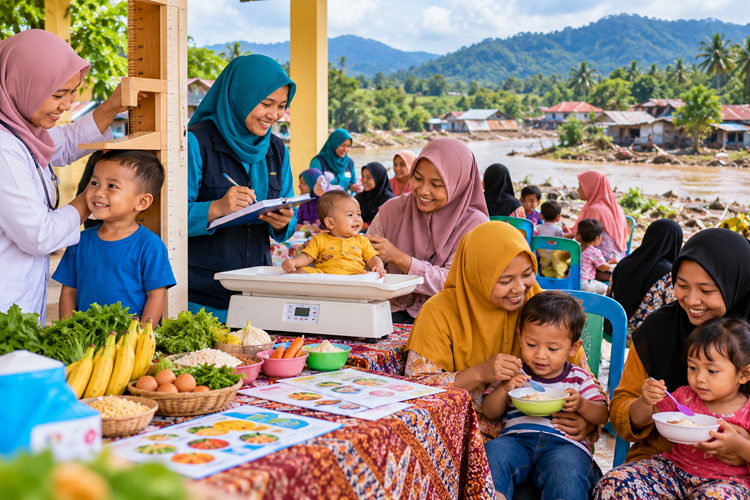
Background: Flood-related disruptions can undermine the continuity of community-based nutrition services, particularly child growth monitoring, nutrition education, and caregiver participation in integrated health posts (Posyandu). Strengthening community engagement and local service capacity is essential for restoring these services in disaster-affected areas. Objective: To describe the implementation and documented outcomes of the “Posyandu Rasa Pesta” community empowerment program in revitalizing post-flood nutrition services in Sipirok, Indonesia.
Methods: A descriptive community engagement approach was implemented at Posyandu Kenanga 1, Sipirok, North Sumatra, Indonesia. The program integrated cadre capacity strengthening, family-centred service activities, nutrition education, promotion of locally sourced supplementary foods, and improved service documentation. Pre-test and post-test assessments involving 33 respondents evaluated social empowerment/service quality and management capacity. Data were analysed descriptively using mean percentage scores and percentage-point differences. Monthly Posyandu records from June to October 2026 were also reviewed.
Results: Social empowerment/service quality scores increased from 40% at pre-test to 75% at post-test, representing a 35-percentage-point improvement. Management capacity scores increased from 35% to 75%, representing a 40-percentage-point improvement. Monthly records consistently listed 33 children under five across five reporting periods. Educational materials and practical service guidelines were also documented as program outputs.
Conclusion: The “Posyandu Rasa Pesta” program was associated with improvements in assessed empowerment and management scores and produced practical resources for community-based nutrition service revitalization. However, the descriptive design does not establish causal effectiveness or improvements in child nutritional status. Further evaluation is needed to assess service continuity and sustainability.
Downloads
References
Abdulai, I. A. (2025). ‘I feed my family but I own no land’: Understanding the complexities of women’s irrigable land access and wellbeing in northern Ghana. World Development Perspectives, 37, 100659. https://doi.org/10.1016/j.wdp.2025.100659
Akter, A., Nishan, M. N. H., Ferdausi, N., & Hossain, M. M. A. Al. (2026). Factors affecting Rohingya mothers’ willingness to embrace online nutrition education for child health in Bangladesh. Health Education, 126(3), 378–395. https://doi.org/10.1108/HE-01-2025-0004
Bogler, L., Varghese, S. S., Sharma, A., Atre, S., Kumar, A., Subramanian, S. V, & Vollmer, S. (2026). Empowering women in rural Bihar: A mixed methods cluster-randomized controlled trial of a large-scale participatory learning and action programme. World Development Perspectives, 43, 100827. https://doi.org/10.1016/j.wdp.2026.100827
Bonis-Profumo, G., Stacey, N., & Brimblecombe, J. (2021). Measuring women’s empowerment in agriculture, food production, and child and maternal dietary diversity in Timor-Leste. Food Policy, 102, 102102. https://doi.org/10.1016/j.foodpol.2021.102102
Borges do Nascimento, I. J., Abdulazeem, H. M., Weerasekara, I., Marquez, J., Vasanthan, L. T., Deeken, G., Morgan, R., Tan, H.-L., Yordi Aguirre, I., Østeengaard, L., Kularathne, I., Azzopardi-Muscat, N., van Kessel, R., Martinez, E. Z., Permanand, G., & Novillo-Ortiz, D. (2025). Transforming women’s health, empowerment, and gender equality with digital health: evidence-based policy and practice. The Lancet Digital Health, 7(6), 100858. https://doi.org/10.1016/j.landig.2025.01.014
Cheney, A., Ramirez, A., Vázquez, E., Tovar, A., Mujuru, P., Ortiz, G., Zimmer, A., & Carrillo, D. (2025). Adapting an Evidence-Based Infant Feeding and Nutrition Program to Promote Healthy Growth and Development in Latinx Families of Low Income. Journal of Nutrition Education and Behavior, 57(7), 572–587. https://doi.org/10.1016/j.jneb.2025.02.007
Dahal, A., Karki, R., Shrestha, R., Ryan, E. P., & Taren, D. (2026). Mothers’ perceptions, acceptability, and feeding practices of rice bran for children: A study of household and stakeholder perspectives. Food and Humanity, 6, 101121. https://doi.org/10.1016/j.foohum.2026.101121
Hadisuyatmana, S., Has, E. M. M., Sebayang, S. K., Efendi, F., Astutik, E., Kuswanto, H., & Arizona, I. K. L. T. (2021). Women’s Empowerment and Determinants of Early Initiation of Breastfeeding: A Scoping Review. Journal of Pediatric Nursing, 56, e77–e92. https://doi.org/10.1016/j.pedn.2020.08.004
He, C., Madzorera, I., Passarelli, S., Ambikapathi, R., Gunaratna, N. S., Berhane, Y., Abdelmenan, S., Canavan, C. R., Noor, R. A., Sibanda, L. M., & Fawzi, W. (2026). Effectiveness of integrated chicken production and nutrition-sensitive interventions on females’ dietary diversity outcomes: a cluster-randomized controlled trial in rural Ethiopia. The American Journal of Clinical Nutrition, 124(4), 101475. https://doi.org/10.1016/j.ajcnut.2026.101475
Heckert, J., Olney, D. K., & Ruel, M. T. (2019). Is women’s empowerment a pathway to improving child nutrition outcomes in a nutrition-sensitive agriculture program?: Evidence from a randomized controlled trial in Burkina Faso. Social Science & Medicine, 233, 93–102. https://doi.org/10.1016/j.socscimed.2019.05.016
Ingabire-Gasana, E., & Murimi, M. (2025). Impact of Harvest Lentil Vegetable Blend and Nutrition Education on Child Growth, Caregivers’ Nutrition Knowledge, and WASH Practices. Journal of Nutrition Education and Behavior, 57(2), 111–119. https://doi.org/10.1016/j.jneb.2024.09.009
Katiyatiya, C. L. F., & Ncanywa, T. (2026). Amaranth as a sustainable feed resource for livestock. Veterinary and Animal Science, 31, 100586. https://doi.org/10.1016/j.vas.2026.100586
Lecoutere, E., van den Berg, M., & de Brauw, A. (2023). Changes in women’s empowerment in the household, women’s diet diversity, and their relationship against the background of COVID-19 in southern Bangladesh. Journal of Asian Economics, 84, 101559. https://doi.org/10.1016/j.asieco.2022.101559
Makwela, M. S., Ntimana, C. B., & Mashaba, R. G. (2026). Investigating interventions to mitigate sub-optimal complementary feeding among children aged 6–23 months in Africa: A scoping review. Clinical Nutrition Open Science, 67, 100643. https://doi.org/10.1016/j.nutos.2026.100643
Ndagijimana, A., Wiklund, M., & Lind, T. (2027). Parental experiences and understandings of stunting in children aged 1–36 mo in the Northern Province of Rwanda. Nutrition, 153, 113411. https://doi.org/10.1016/j.nut.2026.113411
Okogun, O. (2026). Enhancing educational and health outcomes through school feeding programs: A study of Nigerian children. International Journal of Educational Development, 125, 103634. https://doi.org/10.1016/j.ijedudev.2026.103634
Pathak, C. R., Luitel, H., Pakhrin, W. T., Syahrulawal, L., Pandey Sadaula, G., Bhandari, D. R., Koirala, S., & Khanal, P. (2025). Nutritional potential of the giant African land snail (Achatina fulica) as a sustainable protein source for food and feed. Journal of Agriculture and Food Research, 23, 102179. https://doi.org/10.1016/j.jafr.2025.102179
Pienaah, C. K. A., Molle, M. N., & Luginaah, I. (2025). The role of child nutrition counselling, gender dynamics, and intra-household feeding decision-making on child dietary diversity in semi-arid northern Ghana. Appetite, 204, 107755. https://doi.org/10.1016/j.appet.2024.107755
Singh, S., Jordan, I., Hunter, D., Milani, P., Muthoni, P., & Borelli, T. (2026). Promoting climate-resilient agriculture and food security through school feeding. The Lancet Planetary Health, 10(2), 101414. https://doi.org/10.1016/j.lanplh.2025.101414
Suprapto, S., Arda, D., & Kurni Menga, M. (2024). Community empowerment in an effort towards quality health. Jurnal Pengabdian Masyarakat Edukasi Indonesia, 1(2), 49–55. https://doi.org/10.61099/jpmei.v1i2.40
Susanto, T., Rasni, H., & Wuryaningsih, E. W. (2026). “It’s Hard to Feed Them Right”: A Phenomenological Analysis of Dietary Diversity, Family Sanitation, and Food Access in Rural Indonesian Stunting Cases. Journal of Pediatric Health Care. https://doi.org/10.1016/j.pedhc.2026.07.010
Verma, G. S., Gopalakrishnan, L., Ayadi, A. El, Diamond-Smith, N., Bagga, R., Dhir, S. K., Singh, P., Gill, N., Miglani, V., Mutyala, N., Kankaria, A., Kaur, J., Ahuja, A., Kumar, V., & Duggal, M. (2025). Preliminary Effectiveness of a Postnatal mHealth and Virtual Social Support Intervention on Newborn and Infant Health and Feeding Practices in Punjab, India: Quasi-Experimental Pre-Post Pilot Study. JMIR Pediatrics and Parenting, 8, e65581–e65581. https://doi.org/10.2196/65581
Waid, J. L., Wendt, A. S., Sinharoy, S. S., Kader, A., & Gabrysch, S. (2022). Impact of a homestead food production program on women’s empowerment: Pro-WEAI results from the FAARM trial in Bangladesh. World Development, 158, 106001. https://doi.org/https://doi.org/10.1016/j.worlddev.2022.106001
Wouk, K., Bridgman, J., Huntley, D., Brand, C., Koyama, N., Torian, S., & Palmquist, A. E. L. (2025). Systematic Review of Human Milk Feeding Practices and Policies in Infant and Young Child Feeding Trainings for Early Care and Education Providers. Journal of Nutrition Education and Behavior, 57(10), 943–961. https://doi.org/10.1016/j.jneb.2025.05.198
Yang, K. P., Bray, T. M., Chaudhuri, A., Syam, S. B., & Khanna, S. K. (2025). Barriers to child nutrition in Bengaluru slums: Caregiver insights from the SCOPE strategy. Evaluation and Program Planning, 111, 102612. https://doi.org/10.1016/j.evalprogplan.2025.102612
Yao, Z., Li, Y., Ouyang, H., Lin, G., Li, Y., Yan, H., Qin, F., Yao, J., & Chen, Y. (2026). A journey map of caregivers for children with developmental dysplasia of the hip in Guangzhou, China: A qualitative study based on empowerment theory. Journal of Pediatric Nursing, 89, 528–536. https://doi.org/10.1016/j.pedn.2026.05.018
Downloads
Published
How to Cite
Issue
Section
Citation Check
License
Copyright (c) 2026 Haslinah Haslinah, Ahmad Riza Siregar, Fatma Mutia, Adi Antoni

This work is licensed under a Creative Commons Attribution 4.0 International License.