
Stunting among under-five children in remote indonesia: associations with feeding practices, immunization adherence, and safe water use
DOI:
https://doi.org/10.61099/jih.v2i4.557Keywords:
child nutrition, immunization, stunting, water supplyAbstract
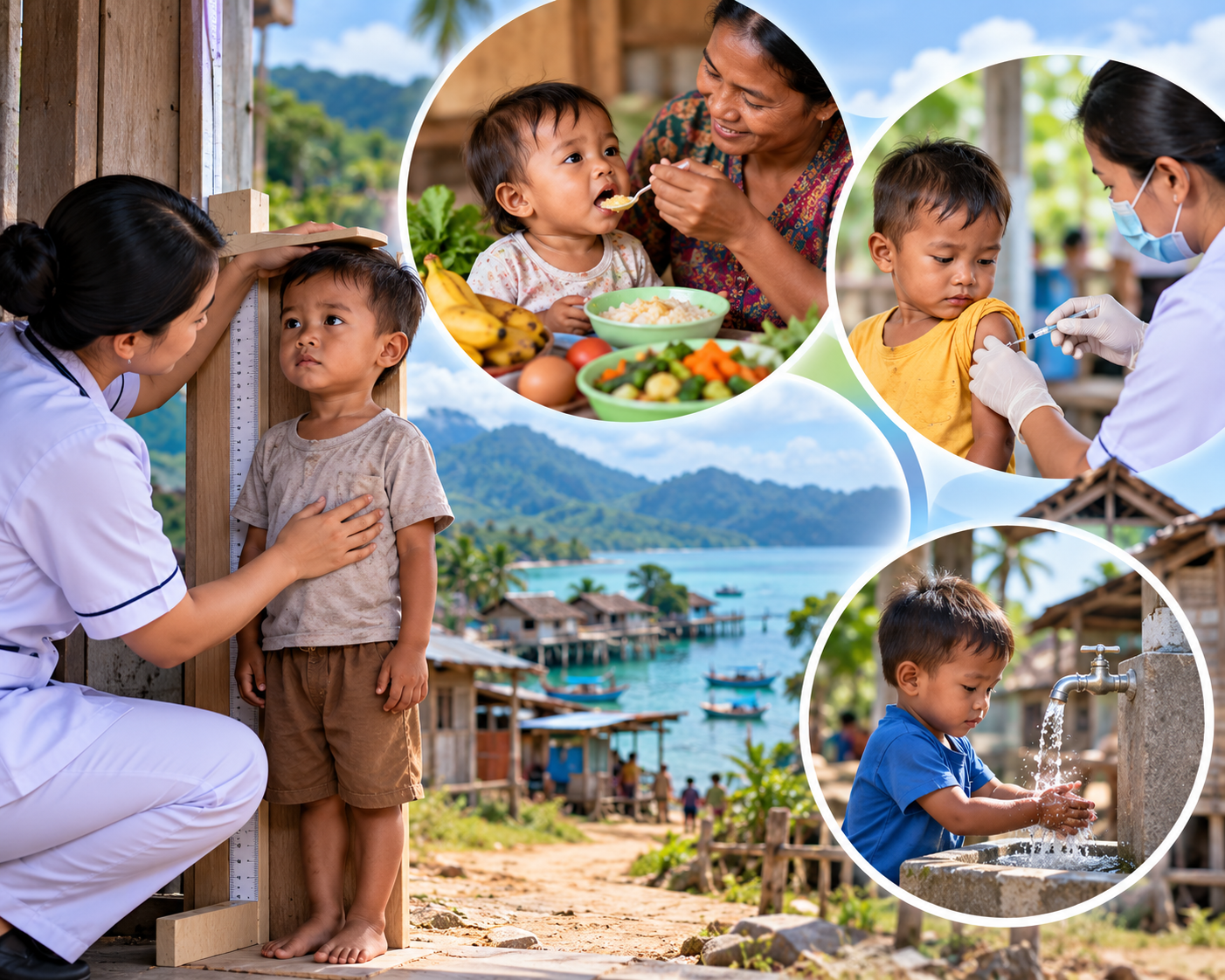
Introduction: Childhood stunting remains a major public health concern, particularly in remote areas where nutritional inadequacy, limited access to preventive health services, and unsafe household water may occur simultaneously. This study examined the associations of feeding practices, immunization adherence, and clean water use with stunting among under-five children in the Arimop Public Health Center area, Boven Digoel Regency, Indonesia.
Research Methodology: An observational analytic study with a cross-sectional design was conducted in July 2026. The study population comprised 296 registered under-five children, from whom 75 children were selected using purposive sampling. Data were obtained through questionnaires and anthropometric measurements. Descriptive and bivariate analyses were performed to examine associations between the independent variables and stunting.
Results: Of the participating children, 53.3% had suboptimal feeding practices, 44.0% had incomplete or non-adherent immunization, and 30.7% used household water that did not meet health requirements. Stunting was identified in 34.7% of children. Feeding practices, immunization adherence, and clean water use were each significantly associated with stunting (all p<0.001).
Conclusion: Stunting among under-five children was associated with nutritional practices, preventive healthcare adherence, and household water conditions. Integrated prevention should therefore strengthen appropriate child feeding, completion of routine immunization, and access to safe household water, particularly in remote communities.
Downloads
References
1. Agadjanian V, Prata N. Civil war and child health: regional and ethnic dimensions of child immunization and malnutrition in Angola. Soc Sci Med. 2003;56(12):2515-2527. doi:https://doi.org/10.1016/S0277-9536(02)00286-1
2. Asefa A, Girma D, Kaso AW, Ferede A, Agero G, Beyen TK. Prevalence of stunting and associated factors among under-five children in Robe Woreda, Arsi zone, Ethiopia. Int J Africa Nurs Sci. 2024;21:100782. doi:10.1016/j.ijans.2024.100782
3. Batani J, Maharaj MS. Harnessing emerging technologies for sustainable child health: Rethinking strategies for advancing SDG 3.2 in resource-constrained environments. Women Child Nurs. 2024;2(4):75-83. doi:10.1016/j.wcn.2024.09.001
4. Boba HI, Belayneh SB, Melaku FG, Hayelom DH, Bamboro SA. Prevalence and determinants of stunting among children aged 6–59 months in drought-affected pastoralist communities of teltele district, Borena Zone, Oromia Region, Ethiopia: A Cross-Sectional Study. Glob Pediatr. 2026;17:100347. doi:10.1016/j.gpeds.2026.100347
5. Caraka RE, Supardi K, Gio PU, et al. Bayesian Network analysis of spatial disparities in child nutrition status and health determinants across Indonesia. Int J Appl Earth Obs Geoinf. 2025;144(1):104936. doi:10.1016/j.jag.2025.104936
6. Fatima M, Ünsal Ö. Geospatial analysis of diarrhoea determinants among children under five in Pakistan using Multiscale Geographically Weighted Regression (MGWR). Appl Geogr. 2024;172:103434. doi:10.1016/j.apgeog.2024.103434
7. Fuchs GJ. Global Child Nutrition. Gastroenterol Clin North Am. 2025;54(4):681-697. doi:10.1016/j.gtc.2025.08.008
8. Fufa DA. Determinants of stunting in children under five years in dibate district of Ethiopia: A case-control study. Hum Nutr Metab. 2022;30:200162. doi:10.1016/j.hnm.2022.200162
9. Gune S, Alderman H, Nguyen PH, Chakrabarti S. Does Local System Strengthening Improve Nutrition Program Coverage and Child Growth: Evidence from a Large-Scale Program Initiative in India. J Nutr. Published online June 2026:101641. doi:10.1016/j.tjnut.2026.101641
10. Jokhu LA, Syauqy A. Determinants of concurrent wasting and stunting among children 6 to 23 mo in Indonesia. Nutrition. 2024;122:112390. doi:10.1016/j.nut.2024.112390
11. Lewis JI, Mbabazi J, Mutumba R, et al. Correlates of Body Composition in Children with Stunting: A Cross-sectional Study in Uganda. J Nutr. 2024;154(10):3105-3115. doi:10.1016/j.tjnut.2024.08.001
12. Li J. Less stunted? The impact of Chinese health aid on child nutrition. Soc Sci Med. 2024;342:116559. doi:10.1016/j.socscimed.2024.116559
13. Nandi A, Kumar S, Shet A, Bloom DE, Laxminarayan R. Childhood vaccinations and adult schooling attainment: Long-term evidence from India’s Universal Immunization Programme. Soc Sci Med. 2020;250:112885. doi:10.1016/j.socscimed.2020.112885
14. Milman A, Frongillo EA, de Onis M, Hwang J-Y. Differential Improvement among Countries in Child Stunting Is Associated with Long-Term Development and Specific Interventions. J Nutr. 2005;135(6):1415-1422. doi:10.1093/jn/135.6.1415
15. Nadhiroh SR, Micheala F, Tung SEH, Kustiawan TC. Association between maternal anemia and stunting in infants and children aged 0–60 months: A systematic literature review. Nutrition. 2023;115:112094. doi:10.1016/j.nut.2023.112094
16. Oginawati K, Yapfrine SJ, Fahimah N, Salami IRS, Susetyo SH. The associations of heavy metals exposure in water sources to the risk of stunting cases. Emerg Contam. 2023;9(4):100247. doi:10.1016/j.emcon.2023.100247
17. Orimadegun AE, Jegede AS, Gaffey MF, et al. A mixed-methods study of the drivers of stunting reduction among children under five in Nigeria, 2008–2018. Am J Clin Nutr. 2025;121:S86-S94. doi:10.1016/j.ajcnut.2025.02.022
18. Otoo GE, Gaffey MF, Confreda E, et al. A mixed-methods study of the drivers of stunting reduction among children under-5 in Ghana, 2003–2017. Am J Clin Nutr. 2025;121:S95-S105. doi:10.1016/j.ajcnut.2025.02.011
19. Parashar S. Moving beyond the mother-child dyad: Women’s education, child immunization, and the importance of context in rural India. Soc Sci Med. 2005;61(5):989-1000. doi:10.1016/j.socscimed.2004.12.023
20. Pasha M, Shimul MMH, Hossain R, Khandker S, Khan S, Mehriban N. Nutritional status and determinants of malnutrition among under-five children in a specialized hospital in Bangladesh during the COVID-19 pandemic. Clin Nutr Open Sci. 2025;64:192-202. doi:10.1016/j.nutos.2025.10.008
21. Prayitno G, Zuhriyah L, Efendi A, et al. Community-powered environmental pathways to reduce stunting: Food security, social capital, and open innovation in semi-urban Indonesia. Environ Challenges. 2025;21:101350. doi:10.1016/j.envc.2025.101350
22. Wendt A, Hellwig F, Saad GE, et al. Are children in female-headed households at a disadvantage? An analysis of immunization coverage and stunting prevalence: in 95 low- and middle-income countries. SSM - Popul Heal. 2021;15:100888. doi:10.1016/j.ssmph.2021.100888
23. Putri NA, Purwanti R, Panunggal B, Wijayanti L. Determinants of wasting among children aged 6–23 months from low-income households in Indonesia: an analysis of the SSGI 2022. Nutr Food Sci. 2026;56(4):740-753. doi:10.1108/NFS-11-2025-0395
24. Sharma D, Vijin PP, Goyal R, ul Hadi S, Kumar R. Unveiling subgroup trends of stunting and wasting in Indian children: a serial cross-sectional analysis from National Family Health Surveys 3–5. Am J Clin Nutr. 2025;121(5):1077-1089. doi:10.1016/j.ajcnut.2025.01.027
25. Suprapto. Stunting Policy Implementation in Indonesia: A Primary Health Care Perspective. J Ilm Kesehat Sandi Husada. 2026;15(1):347-361. doi:10.35816/jiksh.v15i1.302
26. Wand H, Moodley J, Reddy T, Naidoo S. Geospatial correlations and variations in child mortality and stunting in South Africa: Evaluating distal vs structural determinants. Spat Spatiotemporal Epidemiol. 2024;50:100653. doi:10.1016/j.sste.2024.100653
Downloads
Published
How to Cite
Issue
Section
Citation Check
License
Copyright (c) 2026 Hendra Ruru

This work is licensed under a Creative Commons Attribution 4.0 International License.
Statement:
The authors retain the copyright of this work and grant Journal Interdisciplinary Health the right of first publication. The work is simultaneously licensed under a Creative Commons Attribution 4.0 International License (CC BY 4.0), which permits use, distribution, and reproduction in any medium, provided the original author(s) and the initial publication in this journal are properly credited.
The authors are permitted to copy and redistribute the published version of the work, including posting it to an institutional repository or including it in a book, with acknowledgment of its initial publication in Journal Interdisciplinary Health.


